
Ever switched from a brand-name pill to a cheaper generic - and suddenly felt worse? You’re not crazy. The medicine is the same. The active ingredient? Identical. But your body? It reacts like it’s getting something weaker. That’s not a glitch in your physiology. It’s a glitch in your mind. And it’s costing the U.S. healthcare system over a billion dollars a year.
Same Drug, Different Mindset
A 2014 study at the University of Auckland gave 87 students placebo pills. Half were told they were getting a brand-name painkiller. The other half got the exact same pills, labeled as generic. Both groups had headaches. The brand-labeled group reported 2.3 points less pain on a 10-point scale. The generic-labeled group? Only 1.1 points. The pills were sugar. But the labels? They carried real power. This isn’t rare. In another study, Parkinson’s patients got a placebo injection labeled as a $1,500 treatment. Their motor skills improved by 28%. Same injection, labeled as $100? Almost no improvement. The brain doesn’t care about chemistry. It cares about belief. And when you see a generic pill with a plain label and a low price, your brain quietly assumes: less effective.Price Isn’t Just a Number - It’s a Signal
Think about this: if you walked into a store and saw two identical bottles of water, one priced at $5 and one at $1, which one would you trust more? Even if you knew they came from the same source, your gut says the expensive one is better. That’s not stupidity. It’s evolution. We’ve been conditioned for centuries to link cost with quality. A 2008 Harvard study proved this with electric shocks. Volunteers were told they were getting a painkiller. One group was told it cost $2.50. The other, $0.10. The $2.50 pill reduced pain by 37% more. Same pill. Same dose. Just different price tags. The brain’s reward centers lit up differently. Dopamine surged in the $2.50 group. That’s not magic. That’s biology. This is why brand-name drugs still dominate in patients’ minds - even though generics make up 90% of all prescriptions filled in the U.S. The FDA says they’re equivalent. The World Health Organization says so too. But your brain? It’s still listening to the marketing.The Nocebo Effect: When Your Mind Makes You Sick
It’s not just that generics feel less effective. Sometimes, they feel worse. That’s the nocebo effect - the dark twin of the placebo effect. When you expect side effects, you get them. Even if the drug is harmless. A 2014 meta-analysis looked at statin trials where patients got identical placebos. One group was told it was a brand-name statin. The other, a generic. The generic-labeled group reported more than twice as much muscle pain. Same pill. Same nothing. But the label? It triggered fear. And fear? It makes your body tense up, misinterpret normal sensations, and report pain where none exists. One Reddit user wrote: “Switched from brand Nexium to generic. My GERD came back. My doctor said it’s probably all in my head.” He wasn’t wrong. EEGs and blood tests showed no difference in acid levels. But his brain believed he was getting inferior medicine. And his body responded accordingly. In epilepsy, 39% of patients report more seizures after switching to generics. Neurologists, checking actual brain waves, found 78% of those cases had no physiological change. The seizures were triggered by anxiety, not chemistry.
Why This Matters More Than You Think
Generics save patients an average of $312 a year. They make life-saving drugs accessible to millions. But here’s the catch: 18-24% of people stop taking their generic meds because they think they’re not working. That’s not laziness. It’s a psychological trap. A 2017 JAMA study tracked 38,000 Medicare patients. Those on generics had 12-15% higher hospitalization rates. Not because the drugs failed. Because patients stopped taking them. Or took them inconsistently. Or switched back to expensive brands they couldn’t afford. The result? $318 billion in avoidable medical costs every year - from ER visits to complications from untreated conditions - all tied to perception, not pharmacology.Doctors Are Learning How to Fix This
The good news? This isn’t hopeless. Doctors are learning how to talk about generics so patients actually believe them. A 2018 study at the University of Chicago showed that just a 7-minute conversation - explaining that generics are held to the same FDA standards, that the active ingredient is identical, and that price doesn’t equal quality - boosted patient acceptance from 58% to 89%. Six months later, 72% of those patients were still taking their meds. The control group? Only 44%. Some clinics now train doctors in “positive generic messaging.” Instead of saying, “We’re switching you to a generic,” they say: “This is the exact same medicine as your brand, but it saves you money - and studies show it works just as well.” That small shift? It increased adherence from 63% to 85%. The American Academy of Family Physicians now offers a 3-hour training course on this. Doctors who took it went from feeling 4.2/10 confident talking about generics to 8.7/10. That’s not just knowledge. That’s power.Packaging, Apps, and the Future
Companies are starting to notice. In a 2023 trial, researchers gave hypertension patients generic pills - but put them in sleek, branded-style packaging. No change in the drug. Just the bottle. Result? Nocebo complaints dropped by 37%. The FDA is even backing a free app called “Generic Confidence.” It uses augmented reality to show you side-by-side comparisons of brand and generic pills, highlighting identical active ingredients. In testing, users who used the app were 29% more likely to stick with their generic. And now, Dr. Kate Faasse’s team is launching a $2.1 million NIH-funded study to test whether blockchain labels - showing real-time data on manufacturing quality - can rebuild trust. Imagine scanning a pill bottle and seeing: “This batch passed FDA bioequivalence tests. Same as brand. Made in same facility.” That kind of transparency could change everything.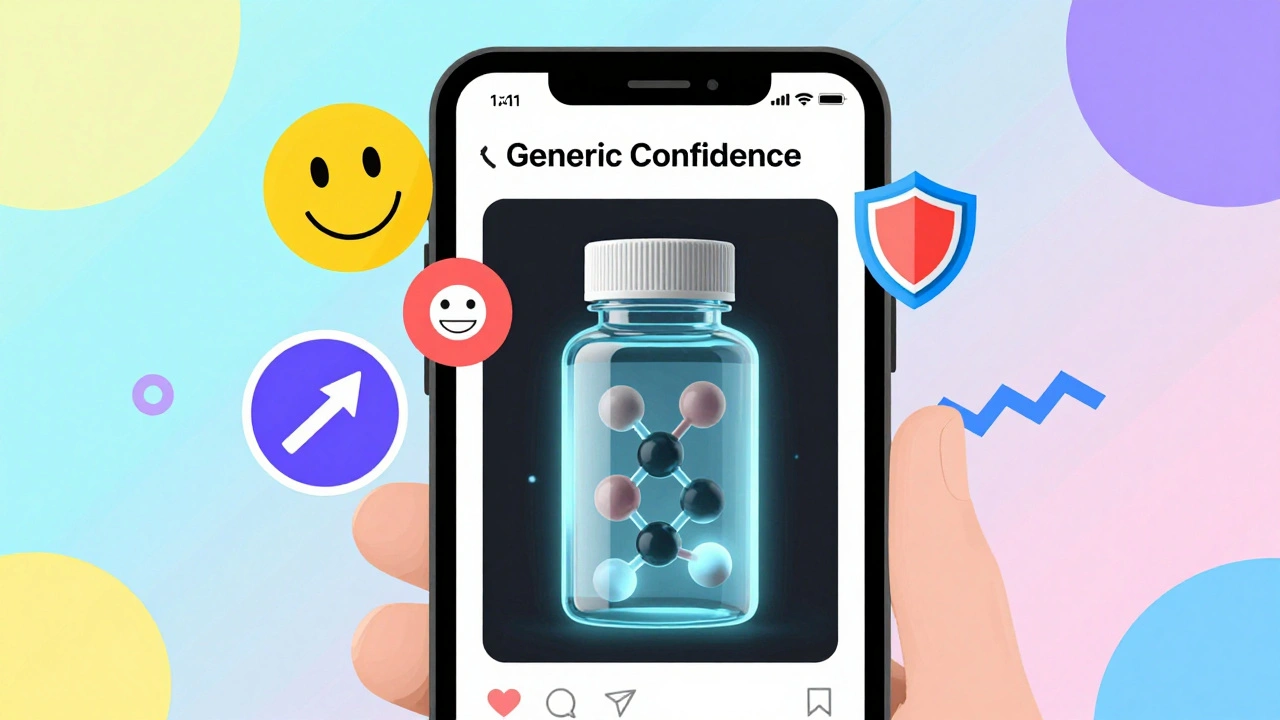
Who’s Most Affected - And Why
This isn’t equal across the board. Older adults - especially those over 65 - are twice as likely to distrust generics. Why? They remember when generics were less reliable. And they’ve been told for decades that “you get what you pay for.” Low-income patients? They’re hit hardest. When you’re struggling to pay rent, a $0.50 pill feels like a bargain. But your brain also links low price with low quality. A 2023 JAMA Psychiatry study found these patients experience 2.3 times stronger nocebo effects. It’s not ignorance. It’s survival psychology. If you’ve been burned before, you assume the cheapest option is the worst. Meanwhile, younger people? They’re catching on. Only 49% of those under 35 distrust generics. Why? They grew up with online reviews, transparency, and access to data. They’ve seen the science. And they’re more likely to trust it.What You Can Do Right Now
If you’re on a generic and feeling off:- Ask your doctor: “Is this exactly the same as the brand?”
- Look up the drug on the FDA’s Orange Book - it lists every generic and its manufacturer.
- Check if your pharmacy switched brands. Sometimes, a different generic maker = different inactive ingredients. That’s rare, but it happens.
- Try the “Generic Confidence” app. It’s free. It’s real. And it works.
The Bottom Line
Generics aren’t cheap versions of real medicine. They’re real medicine - with a cheaper label. The science is clear. The data is solid. The only thing holding them back? Your brain. The placebo effect isn’t about lying to patients. It’s about helping them believe in what’s already true. And when we fix that belief? We don’t just save money. We save lives.Are generic drugs really the same as brand-name drugs?
Yes. By law, generic drugs must contain the same active ingredient, strength, dosage form, and route of administration as the brand-name version. They must also meet the same FDA standards for purity, stability, and bioequivalence (absorbed into the bloodstream at the same rate and amount). The only differences are in inactive ingredients - like fillers or dyes - which don’t affect how the drug works. Studies show generics work just as well in 98.5% of cases.
Why do some people feel worse on generics?
It’s usually the nocebo effect - your brain expects side effects or reduced effectiveness because the pill looks different or costs less. This isn’t imaginary. Your brain actually changes how you feel. Studies show people report more pain, fatigue, or nausea on generics - even when the drug is identical. Anxiety triggers real physical reactions. That’s why explaining the science before switching can cut complaints by over 30%.
Can the packaging of generics affect how well they work?
Yes - not because the medicine changes, but because your expectations do. A 2023 study found that when generic pills were packaged to look like brand-name drugs - similar colors, fonts, and shapes - patients reported fewer side effects and better results. The pill was the same. The belief changed. That’s the power of perception. Some pharmacies are now testing premium packaging to reduce nocebo effects.
Do generics work the same for mental health medications?
They can, but the placebo effect is stronger here. Antidepressants and anti-anxiety meds rely heavily on patient expectation. Studies show generic-labeled versions have 11% lower response rates than brand-labeled ones - even when the drug is identical. This isn’t because generics are weaker. It’s because patients doubt them. When doctors explain bioequivalence upfront, response rates jump to match brand-name levels.
Should I avoid generics because of the placebo effect?
No. Avoiding generics because of fear means paying more and risking your health. Generics save patients an average of $312 a year and make life-saving drugs accessible. The placebo effect can be managed - not eliminated - with good communication. Talk to your doctor. Learn the facts. Use tools like the FDA’s Generic Confidence app. You don’t have to believe in the brand. Just believe in the science.
Is it true that generics have different inactive ingredients that cause problems?
Sometimes. While the active ingredient is always the same, inactive ingredients (like dyes or binders) can vary between generic manufacturers. In rare cases, these can cause allergic reactions or mild digestive issues - but they don’t affect how the drug treats your condition. If you notice a new side effect after switching, tell your doctor. You might need a different generic version. But this isn’t common - and it’s not the same as the placebo effect.
Michael Feldstein
December 2, 2025 AT 14:29So let me get this straight - we’re paying billions because people’s brains won’t accept that a $0.50 pill works the same as a $5 one? That’s wild. I’ve been on generic lisinopril for years. Never felt a difference. But I also don’t care what the bottle looks like. Maybe that’s the key - stop caring.
Still, it’s fascinating how much power branding has. We’re biological machines wired for heuristics. Price = quality. Big pharma = trustworthy. It’s not dumb. It’s evolutionary.
Rachel Bonaparte
December 2, 2025 AT 20:42Oh please. This isn’t psychology - it’s corporate manipulation. Big Pharma spent decades convincing us generics are ‘inferior’ so they could keep raking in profits. Now they’re ‘fixing’ it with apps and blockchain labels? Classic. They created the problem. Now they’re selling the solution. The FDA? They’re on the payroll. The real question is - who owns the patent on your belief system?
And don’t get me started on the ‘Generic Confidence’ app. It’s just another digital placebo. You scan a pill and suddenly feel better? That’s not science. That’s hypnosis with a UI.
Meanwhile, the real issue - drug monopolies, patent trolling, and price gouging - gets buried under feel-good neuroscience. We’re being distracted by the glitter on the pill bottle while they steal our healthcare system.
Rebecca Braatz
December 4, 2025 AT 12:27Hey - if you’re on a generic and feeling off, don’t panic. This is fixable. Talk to your doctor. Use the FDA’s Orange Book. Try the Generic Confidence app. It’s free. It’s real. And it works.
I switched from brand Zoloft to generic sertraline last year. Felt weird at first. Then I read the studies. Watched the videos. Scanned the bottle with the app. And guess what? My anxiety didn’t come back. My brain just needed to catch up.
You’re not broken. Your brain just needs a little rewiring. And you’re not alone. Thousands of us have been there. You got this.
jagdish kumar
December 6, 2025 AT 07:43Belief is the only true medicine.
Everything else is decoration.
Benjamin Sedler
December 6, 2025 AT 20:09Wait - so if I put my generic Adderall in a bottle labeled ‘Pfizer Premium’ and charge $200, it suddenly works better? And if I call it ‘Walgreens Budget Relief,’ I’m basically giving people a sugar cube with a side of existential dread?
That’s not placebo. That’s psychological warfare. And someone’s making a fortune off it. I’m starting a startup. We’re selling branded generic pills with velvet packaging and ASMR unboxing videos. The tagline? ‘Your brain deserves better.’
Who’s in?
zac grant
December 8, 2025 AT 14:42From a clinical perspective, the nocebo effect is one of the most underappreciated confounders in pharmacotherapy. The CNS modulates drug efficacy via top-down pathways - expectancies activate the PAG, ventral striatum, and prefrontal cortex, altering neurotransmitter dynamics in ways that can mimic or mask pharmacological effects.
What’s fascinating is that the effect size in psychotropics is larger than in analgesics - likely due to the higher placebo response rates in depression/anxiety trials. The key intervention isn’t changing the pill - it’s changing the narrative.
And yes, packaging matters. Color psychology, font legibility, even the texture of the blister pack - all influence perceived efficacy. It’s not voodoo. It’s neurophenomenology.
michael booth
December 10, 2025 AT 09:58Generics are not inferior. They are equivalent. The science is unequivocal. The data is overwhelming. The cost savings are transformative. The only barrier is perception.
Let us not confuse the map with the territory. The pill is the pill. The belief is the belief. One is chemical. The other is cognitive. Both are real. Both matter.
Education is not optional. It is essential.
Jenny Rogers
December 12, 2025 AT 00:56It is deeply troubling that we have reached a point where the efficacy of a life-saving medication is contingent upon the aesthetic design of its packaging and the psychological conditioning of the patient. This is not medicine. This is behavioral engineering disguised as healthcare.
The FDA’s role in permitting such a system is a moral failure. If a drug’s therapeutic outcome is dependent on branding, then the entire regulatory framework is compromised. We are not treating patients. We are manipulating their cognitive biases.
And to suggest that a free app can ‘fix’ this is obscene. It is a Band-Aid on a hemorrhage. The solution is not better marketing. It is the dismantling of the profit-driven pharmaceutical model that created this problem in the first place.
Heidi Thomas
December 12, 2025 AT 12:31Stop pretending this is about belief. It’s about corporate fraud. Generic manufacturers are allowed to use different fillers - some of which are known to cause inflammation. The FDA doesn’t require them to test for long-term effects because ‘bioequivalence’ only measures absorption. But what about bioactivity? What about immune response? What about the fact that 70% of generics are made in India and China with zero oversight?
You think your brain is making you feel worse? Maybe it’s the talc. Maybe it’s the dye. Maybe it’s the heavy metals.
Stop blaming psychology. Start blaming regulation.
Alex Piddington
December 13, 2025 AT 02:01Hey, I’ve been prescribing generics for 12 years. Used to get so much pushback. Then I started saying: ‘This is the exact same medicine. Same active ingredient. Same FDA approval. Just cheaper.’
Patients started sticking with it. No more calls about ‘it’s not working.’ No more switching back.
It’s not magic. It’s just clear communication.
And yeah - I use the app too. It’s legit. Try it. 😊
Yasmine Hajar
December 13, 2025 AT 06:41As someone who grew up in a family that couldn’t afford brand-name meds, I remember the shame. Like taking a generic meant you were poor. Like you were settling.
Now I’m a nurse. I’ve seen people on generics live longer, healthier lives because they could actually afford to take them.
It’s not about perception. It’s about survival.
If your brain says it’s not working - talk to someone. Don’t quit. Don’t suffer. There’s a solution. And you’re not alone.
Karl Barrett
December 13, 2025 AT 17:53There’s a deeper truth here: we live in a world where value is assigned by perception, not substance. We pay more for bottled water because it’s in a fancy glass. We trust a doctor in a white coat more than one in jeans. We believe in the brand because we fear the unknown.
Generics don’t fail. Our mythology fails us.
And yet - isn’t that the essence of being human? We are meaning-making creatures. We need stories. Even about pills.
So maybe the real question isn’t how to fix the placebo effect.
It’s how to give people better stories to believe in.
Jake Deeds
December 14, 2025 AT 23:52Let’s be real - this entire post is just a long-winded excuse for Big Pharma to keep charging $200 for a pill that costs 2 cents to make.
They don’t care if you believe in generics. They care that you believe in *them*.
That’s why they’re funding ‘Generic Confidence’ - to make you feel guilty for doubting the system that’s robbing you.
Meanwhile, your insulin is still $300. Your EpiPen is still $600.
So go ahead. Scan your pill. Believe in the app.
But don’t forget - the real villain isn’t your brain.
It’s the boardroom.
Isabelle Bujold
December 16, 2025 AT 10:35Here’s what nobody talks about: the inactive ingredients in generics aren’t always benign. I had a patient - 72, on generic metformin - developed chronic diarrhea after the switch. Blood work? Normal. Glucose? Controlled. But the diarrhea? Unrelenting.
Turns out, the generic used a different binder - microcrystalline cellulose vs. pregelatinized starch. Her gut couldn’t tolerate it. Switched back to brand - gone in 48 hours.
So yes, the active ingredient is identical. But fillers? They’re not inert. They’re pharmacologically active in ways we barely understand.
And yes - the nocebo effect is real. But so is the fact that not all generics are created equal. The FDA’s bioequivalence standards are laughably low. 80–125% AUC? That’s a 56% window. That’s not ‘same.’ That’s ‘close enough.’
And if you’re diabetic? Or epileptic? Or on a narrow therapeutic index drug? That 56% window can kill you.
So don’t just ‘believe.’ Verify. Check the manufacturer. Look up the batch. Don’t let the placebo narrative erase the real risks.
George Graham
December 17, 2025 AT 14:54My dad’s on a generic statin. He started having muscle pain. Thought it was the pill. Stopped taking it. Ended up in the ER with a mini-stroke.
Turns out - he had a vitamin D deficiency. The pain was from that. But he blamed the generic. Classic nocebo.
Doctors need to talk about this *before* the switch. Not after the panic.
Just like we warn about side effects, we should warn about *belief* effects.
It’s not about trust. It’s about preparation.
John Filby
December 19, 2025 AT 03:44So I tried the Generic Confidence app. Scanned my generic citalopram. Saw the comparison with Celexa. Same active ingredient. Same manufacturer (same factory even).
And guess what? I felt… weirdly better.
Not because the pill changed. But because my brain stopped screaming ‘this is trash.’
It’s like when you find out your favorite band’s song was recorded in a garage - suddenly you love it more.
Knowledge is the real placebo.
Thanks for this. 😊
Joe Lam
December 19, 2025 AT 07:13Actually, I think this whole thing is a scam. The FDA lets generics through because they’re bribed. The studies are funded by generic manufacturers. The ‘identical’ claim? Bullshit.
And the ‘app’? Just another way to sell ads.
Real medicine comes from Germany. Or Switzerland. Not some factory in Bangalore.
Stick with the brand. Pay more. Live longer.
Carolyn Ford
December 19, 2025 AT 16:08Oh, so now it’s our fault we feel worse on generics? We’re just ‘irrational’? We’re just ‘brainwashed’? What about the decades of advertising that told us brand = quality? What about the doctors who said, ‘I only prescribe brand’? What about the fact that the same companies that make the brand also make the generic - but charge 10x more for the same pill?
Stop gaslighting patients. Start holding corporations accountable.
And if your ‘solution’ is an app… then you’re part of the problem.
michael booth
December 20, 2025 AT 07:22Thank you for sharing your experience. Your point about corporate accountability is valid. But let us not discard the science because of systemic failure. The truth remains: generics work. The system is broken. The medicine is not.
We must fix the system. But we must also empower patients with truth.
Both are necessary.