When you pick up a cheap antibiotic or blood pressure pill, there’s a high chance it traveled through Asia before reaching your local pharmacy. In 2024, the global generics market hit $448.6 billion, and Asia produced nearly 39% of that volume. But behind those numbers lies a complex web of manufacturing hubs, regulatory hurdles, and shifting geopolitical tides that directly affect drug prices and availability worldwide.
If you’re a healthcare professional, procurement manager, or just someone curious about where their medicine comes from, understanding the dynamics between India, China, and emerging players like Vietnam is crucial. These markets aren’t just competitors; they are interdependent partners with distinct strengths and weaknesses. India dominates in finished dosage forms, while China controls the raw materials. Meanwhile, smaller economies are carving out niche roles that could reshape the supply chain in the coming decade.
The Big Two: India’s Volume Powerhouse vs. China’s Value Leader
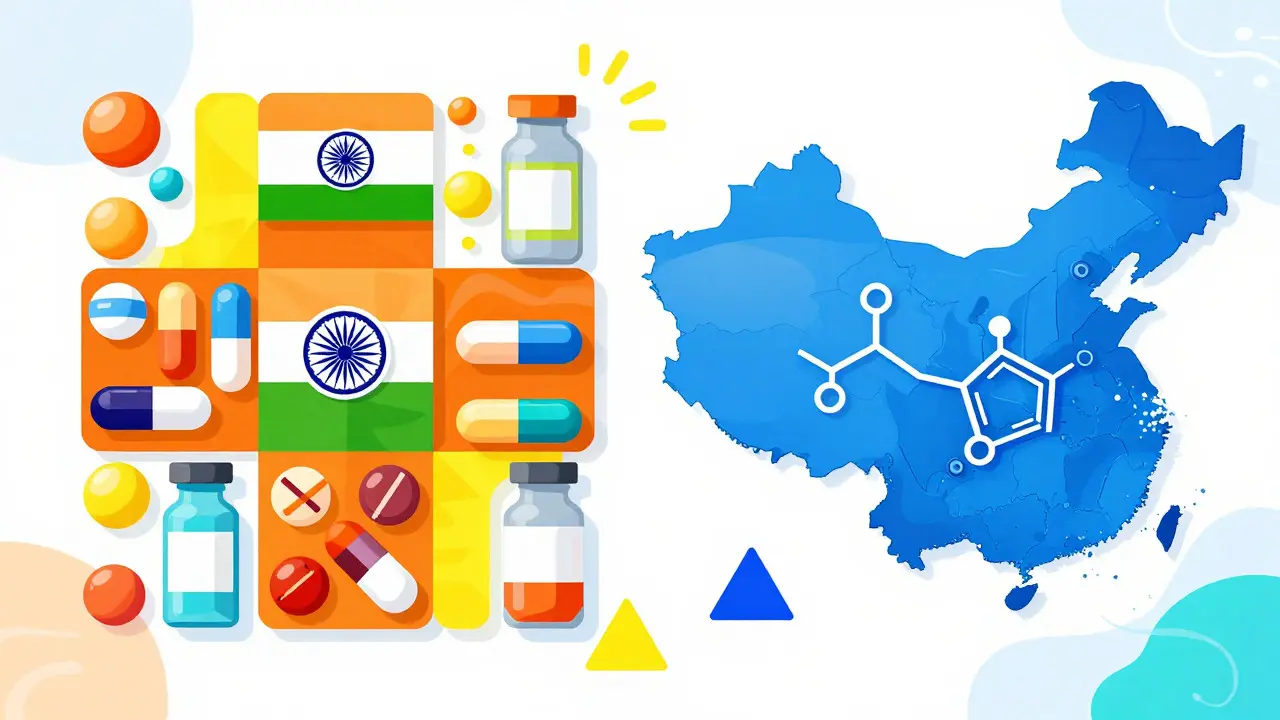
To understand the Asian generic landscape, you have to look at the two giants first. They play very different games. India is often called the "pharmacy of the world" for good reason. It supplies over 60% of the world's generic vaccines and 40% of the U.S. generic drug demand. The country’s pharmaceutical market reached approximately $61.36 billion in 2024, growing at a robust 9.9% CAGR. This growth is driven by a massive domestic population and an export-oriented model focused on cost-effective small-molecule drugs.
On the other side of the map, China operates as the backbone of global pharmaceutical inputs. Its market size is larger, hitting $80.4 billion in 2024, but it grows slightly slower at around 5.4-7.8%. Why? Because China has moved up the value chain. While India excels in finished pills, China controls roughly 70% of the global Active Pharmaceutical Ingredient (API) market. If you want to make a generic drug, you likely need an API from China. This gives Beijing significant leverage over global production costs and timelines.
| Feature | India | China |
|---|---|---|
| Market Size (2024) | $61.36 Billion | $80.4 Billion |
| Primary Strength | Finished Dosage Forms (Generics) | Active Pharmaceutical Ingredients (APIs) |
| Global Share | ~20% of generic volume | ~70% of API supply |
| Growth Rate (CAGR) | 9.9% | 5.4% - 7.8% |
| Key Manufacturing Hubs | Gujarat, Maharashtra | Jiangsu, Zhejiang, Shanghai |
| Innovation Focus | Biosimilars & Complex Generics | Biologics & Traditional Medicine |
The strategic implication here is clear: India wins on speed and finished product variety, while China wins on raw material control and higher-margin products. For global buyers, this creates a dual-sourcing necessity. You can’t rely on just one. A German procurement manager recently noted that while Chinese APIs are 20% cheaper than Indian alternatives, the quality risks forced them to implement costly dual-sourcing strategies, increasing overall supply chain costs by 18%. That trade-off is becoming the new normal.
Emerging Players: Vietnam, Cambodia, and the New Niches
While India and China dominate headlines, the real action for future supply chain resilience is happening in Southeast Asia. Countries like Vietnam are capturing specific niches with impressive speed. Its pharmaceutical market grew at a 12.3% CAGR between 2020 and 2024, largely driven by specialized antibiotic intermediates. By 2024, Vietnam’s pharma exports hit $2.8 billion, a 24.7% jump year-over-year. Why Vietnam? Lower labor costs than China, better infrastructure than its neighbors, and favorable ASEAN trade preferences make it an attractive alternative for mid-tier manufacturing.
Cambodia is taking a different approach. Instead of competing on complex drug synthesis, it’s focusing on low-cost medical device assembly. This sector grew by 18% annually, reaching $1.2 billion in 2024. For companies looking to diversify away from Chinese dominance in basic medical supplies, Cambodia offers a viable, if less sophisticated, option. These emerging economies aren’t trying to replace India or China overnight; they are filling the gaps in the middle tier of the supply chain, offering flexibility and reduced geopolitical risk.

Quality, Regulation, and the Cost of Trust
Price isn't the only factor driving sourcing decisions anymore. Quality assurance and regulatory compliance have become critical pain points. The U.S. FDA issued 142 warning letters to Chinese manufacturers in 2024, compared to 87 for Indian facilities. This statistic highlights a persistent challenge: while Chinese pricing is competitive, the consistency of quality can be unpredictable. In contrast, Indian suppliers often score higher on communication and responsiveness, with an average Trustpilot rating of 4.1/5.0 versus 3.8/5.0 for Chinese peers.
However, India has its own regulatory headaches. Navigating 17 different federal and state-level regulatory bodies can delay approvals significantly. Procurement officers report that 47% face significant delays due to these state-level discrepancies. China, conversely, has centralized its processes under the National Medical Products Administration (NMPA), which has streamlined approval times from 24 months in 2018 to just 9 months in 2024. So, if you need speed and standardized processes, China might be faster. If you need flexible formulation support and better customer service, India often edges out. The choice depends entirely on what you prioritize: speed of entry or agility in product development.
The API Chokehold and Self-Sufficiency Pushes
One of the biggest vulnerabilities in the global system is the dependence on Chinese APIs. India imports 68% of its required APIs from China. To break this dependency, New Delhi launched the 'Pharma 2047' initiative, allocating $13.4 billion to build 12 new API parks and reduce import reliance to 30% by 2030. Similarly, China is pushing for self-sufficiency in higher-value segments, redirecting funds toward biologics innovation.
This race for self-sufficiency has a potential downside: price volatility. S&P Global Ratings warns that overcapacity in API production could trigger 15-20% price corrections in 2026-2027 as both nations try to fill their domestic needs simultaneously. For global buyers, this means hedging strategies are no longer optional. You need contracts that account for raw material swings, not just fixed unit prices. The era of stable, predictable API pricing may be ending, replaced by a more volatile market influenced by national policy goals rather than pure market forces.
Future Outlook: Biologics and Digital Health
Where is this all heading? Both giants are pivoting from simple generics to higher-value biologics and biosimilars. China’s 'Healthy China 2030' amendment directs $22.8 billion toward biologics, aiming for 25% of its exports to be high-value biologics by 2030. India is investing heavily in digital health infrastructure, spending $2.8 billion in 2024 alone, leveraging its young demographic (65% under 35) to drive adoption of telemedicine and AI-driven diagnostics.
For stakeholders, the message is clear. The next decade will see a shift from "cheapest source" to "most reliable partner." Expect tighter integration between Asian manufacturers and Western pharma companies, with joint ventures becoming more common to share risk and expertise. Whether you are a hospital administrator negotiating drug contracts or an investor analyzing pharma stocks, keep an eye on the balance between Indian volume and Chinese value. The dynamic tension between these two powers, plus the rising influence of Southeast Asia, will define the global healthcare supply chain for years to come.
Which country is the largest producer of generic medicines?
India is widely considered the largest producer of generic medicines by volume, supplying over 60% of global generic vaccine demand and 40% of U.S. generic drug demand. However, China leads in the production of Active Pharmaceutical Ingredients (APIs), which are the raw materials needed to make these medicines.
Why is China so important for the global pharmaceutical supply chain?
China controls approximately 70% of the global Active Pharmaceutical Ingredient (API) market. Since almost every drug requires an API, China’s dominance in this segment gives it significant leverage over production costs and supply timelines for manufacturers worldwide, including in India and the West.
Are Vietnamese pharmaceuticals a viable alternative to Indian or Chinese ones?
Yes, particularly for specific niches. Vietnam is rapidly growing in antibiotic intermediates and mid-tier manufacturing, with exports growing 24.7% in 2024. It offers lower labor costs than China and better infrastructure than some regional neighbors, making it a strong candidate for diversifying supply chains away from the two dominant giants.
What is the main difference between Indian and Chinese pharma regulations?
India has a fragmented regulatory system involving 17 federal and state-level bodies, which can cause delays. China has a more centralized system under the NMPA, which has streamlined approval processes, reducing timelines from 24 months to 9 months in recent years. This makes China faster for standardized approvals, while India may offer more flexibility in custom formulations.
How are India and China trying to reduce their dependence on each other?
India is launching the 'Pharma 2047' initiative with $13.4 billion investment to build local API capacity and reduce Chinese imports from 68% to 30% by 2030. China is focusing on moving up the value chain into biologics and innovative drugs, reducing its role as a mere raw material supplier and increasing its share of high-value finished products.