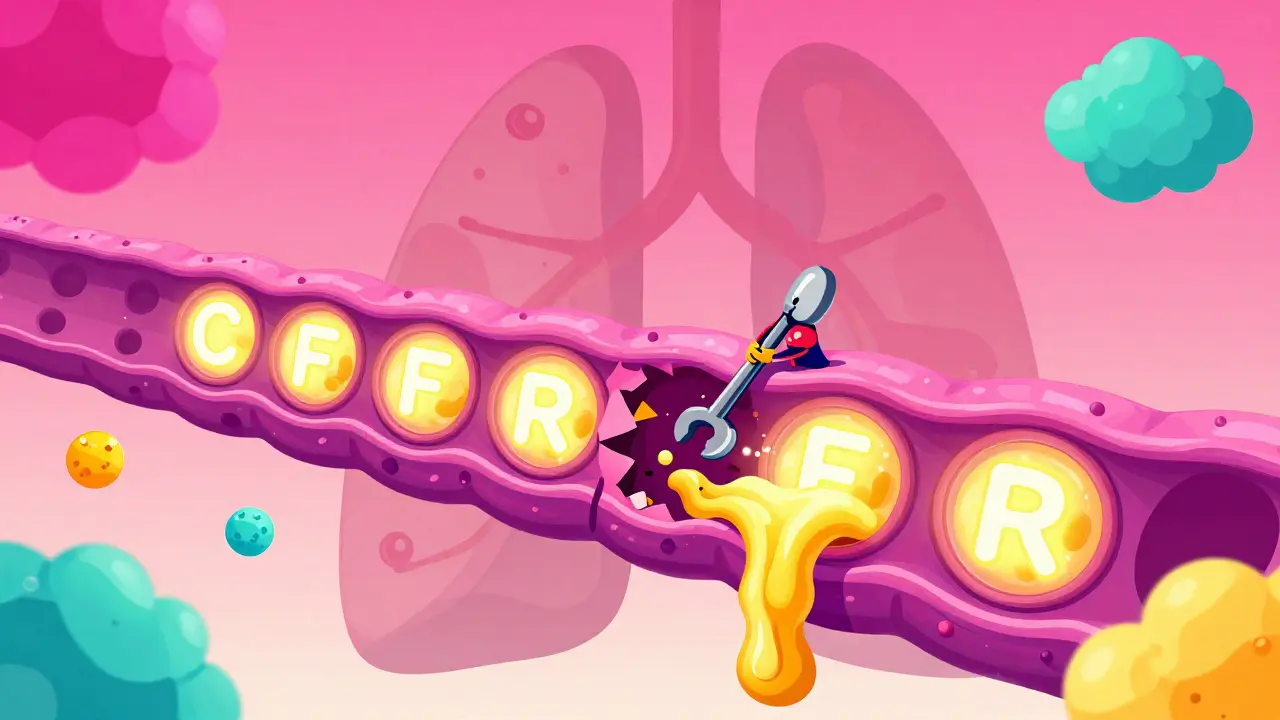
Cystic fibrosis isn't just a lung disease. It’s a full-body genetic condition that changes how salt and water move in and out of cells, turning mucus from slippery to sticky. That thick mucus clogs the lungs, pancreas, liver, and reproductive system - and for decades, it meant most kids with CF didn’t live to see adulthood. Today, that story is changing. Thanks to breakthrough drugs that fix the root cause, not just the symptoms, people with cystic fibrosis are living longer, healthier lives than ever before.
What Causes Cystic Fibrosis?
Cystic fibrosis happens because of a broken gene - the CFTR gene on chromosome 7. This gene normally makes a protein that acts like a gate, letting chloride ions move in and out of cells. When that gate doesn’t work right, salt and water get stuck, and mucus turns thick and gummy. You need two broken copies of this gene - one from each parent - to have CF. If you only have one, you’re a carrier. You won’t have symptoms, but you can pass the mutation to your kids.
There are over 2,000 known CFTR mutations. The most common one, F508del, shows up in about 70% of cases worldwide. But mutation types vary by ethnicity. For example, R117H is more common in people of European descent, while W1282X is more frequent in Ashkenazi Jewish populations. That’s why genetic testing matters - not just for diagnosis, but for figuring out which treatments might work.
How It Affects the Body
The sticky mucus doesn’t just make you cough. It traps bacteria in the lungs, leading to constant infections. Pseudomonas aeruginosa and Staphylococcus aureus are the usual suspects, and over time, they destroy lung tissue. About 85% of CF-related deaths are from respiratory failure.
In the pancreas, mucus blocks the ducts that carry digestive enzymes. Without those enzymes, food doesn’t break down properly. Around 85% of people with CF need to take pancreatic enzyme capsules with every meal - sometimes 6 to 12 at a time. That’s why many struggle with weight gain and malnutrition, even if they eat a lot.
The liver gets clogged too. About 30% of people with CF develop bile duct issues that can lead to scarring. And in males, the tubes that carry sperm are often missing from birth - 97-98% of men with CF are infertile. Women can have trouble conceiving due to thick cervical mucus, but pregnancy is still possible with medical support.
The sweat test is still the gold standard for diagnosis. People with CF have sweat with chloride levels over 60 mmol/L. That’s why newborn screening now happens in all 50 U.S. states - catching it early means starting treatment before damage sets in.
The Old Way: Managing Symptoms
Before modulators, treatment was all about damage control. A typical day for an adult with CF might include:
- 90 minutes of airway clearance - using a vest, a handheld device, or chest percussion to shake mucus loose
- 4 to 6 different inhaled meds - antibiotics, bronchodilators, mucus thinners
- 6 to 12 enzyme capsules with every meal
- High-calorie supplements and vitamin pills
That’s 2 to 3 hours a day, every single day. And even with all that, lung function slowly declined. In 1960, the median life expectancy was just 14 years. By 2000, it had climbed to 31. But the real shift started in 2012.

The New Era: CFTR Modulators
The first CFTR modulator, ivacaftor (Kalydeco), was approved in 2012. It worked for people with the G551D mutation - a rare one, affecting only about 4% of CF patients. But it was a game-changer. In clinical trials, users saw a 10.6% jump in lung function (FEV1). That’s huge for a disease where 1% improvement is considered meaningful.
Then came triple-combination therapy: elexacaftor/tezacaftor/ivacaftor (Trikafta). Approved in 2019, it works for people with at least one F508del mutation - which covers about 90% of the CF population. In trials, it boosted FEV1 by 13.8% and cut lung flare-ups by 63%. One patient in a CF support group said their daily airway clearance dropped from 90 minutes to 20 minutes within three months.
By 2023, the Cystic Fibrosis Foundation confirmed that 90% of people with CF in the U.S. had access to at least one modulator. Median survival jumped to 50.9 years. For the first time, most people with CF are adults - 52% are over 18. That’s a 25-point increase since 1990.
The Catch: Cost and Access
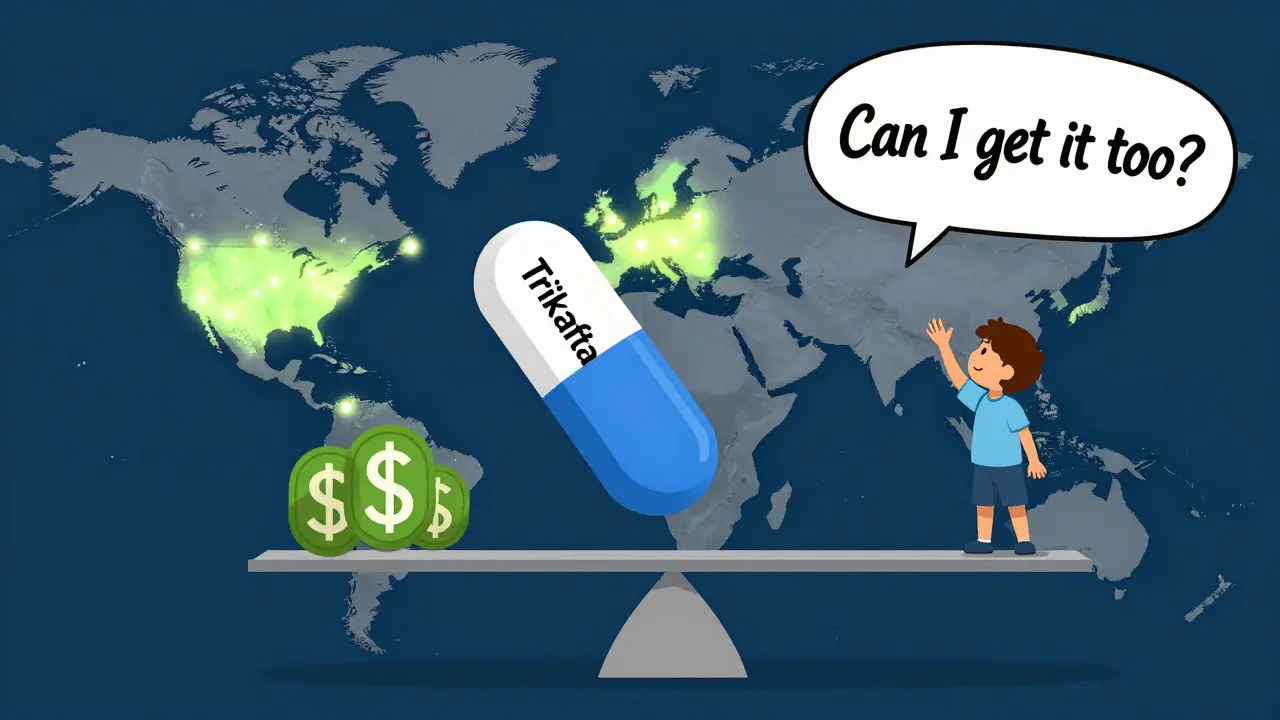
These drugs work - but they’re expensive. Trikafta costs about $300,000 a year in the U.S. Even with insurance, patients report out-of-pocket costs of $1,200 a month. A 2022 survey found 42% of modulator users felt financial strain.
Globally, the gap is worse. Only 35% of the world’s CF population has access to modulators. In low- and middle-income countries, that number drops below 10%. Most deaths from CF now happen in places where these drugs aren’t available.
Vertex Pharmaceuticals holds 95% of the modulator market. The Cystic Fibrosis Foundation helped fund the early research - investing $150 million in the 2000s - but the pricing model hasn’t kept up with global need.
Who Still Doesn’t Benefit?
Not everyone can take modulators. About 10% of people have mutations that don’t respond to current drugs - mostly Class I mutations, like nonsense mutations that stop the protein from being made at all. For them, modulators offer no help.
Some patients also can’t tolerate the side effects. Liver enzyme spikes happened in 3.2% of users in phase 4 studies. A few had to stop treatment. Others report headaches, diarrhea, or mood changes.
That’s why research hasn’t stopped. The Cystic Fibrosis Foundation is now funding 15 active clinical trials. One targets nonsense mutations with mRNA therapy (Ataluren). Another uses CRISPR gene editing to fix the CFTR gene directly. There’s also new inhaled antibiotics designed to fight stubborn Pseudomonas biofilms.
What’s Next?
Trikafta was approved for kids as young as 2 in early 2023. That means more children will start treatment before lung damage begins. The goal isn’t just to extend life - it’s to let kids with CF grow up without the daily grind of treatments.
Long-term, scientists are looking at gene therapy that could permanently fix the CFTR gene. It’s still early, but early trials show promise. The Foundation’s ‘Path to a Cure’ initiative has committed $100 million to target the 10% left behind.
For now, the biggest challenge isn’t science - it’s equity. A drug that can turn a fatal childhood disease into a manageable condition shouldn’t be a luxury only some can afford. The progress made since 2012 proves what’s possible. Now, the question is: who gets to benefit?
Living With CF Today
People with CF are thriving in ways their parents never imagined. They’re going to college, starting careers, traveling, having families. Many are on modulators and feel like they’ve gotten their lives back.
But the burden hasn’t disappeared. Even with better drugs, daily routines are still intense. Airway clearance, meds, enzymes, nutrition - it’s a full-time job. Support networks matter. The Cystic Fibrosis Foundation runs 260 accredited care centers in the U.S. and offers 24/7 clinical advice. Online communities like CF Buddy Connect have over 12,500 active users sharing tips, struggles, and wins.
The message from patients is clear: these drugs aren’t a cure. But they’re the closest thing we’ve ever had.



Solomon Ahonsi
February 3, 2026 AT 04:20This whole modulator thing is a scam. $300k a year for a drug that barely makes you feel normal? They're milking the sick for profit and calling it progress. Meanwhile, my cousin in India still dies at 18 because some CEO thinks his yacht is more important than her life.
George Firican
February 3, 2026 AT 17:43It's fascinating how we've shifted from treating symptoms to correcting the very architecture of cellular function. The CFTR protein isn't just a gate-it's a conductor of ion harmony, and when it fails, the entire symphony of osmotic balance collapses into a thick, suffocating dirge. We're not merely extending life; we're redefining what it means to be human in the face of genetic determinism. The real tragedy isn't the cost-it's that we've proven we can fix this, yet choose not to for everyone.
Matt W
February 5, 2026 AT 11:41My sister’s been on Trikafta for two years now. She went from coughing all night to hiking weekends. I cried when she told me she forgot her inhaler and didn’t even panic. That’s not medicine-that’s magic. Still, the price tag makes me sick. How do we let this happen?
Anthony Massirman
February 6, 2026 AT 23:12Trikafta changed everything. No more 90-minute vests. Just life.
Murarikar Satishwar
February 8, 2026 AT 15:02While the science behind CFTR modulators is undeniably impressive, it is imperative that we address the ethical implications of global access disparities. The fact that 90% of patients in high-income nations benefit while fewer than 10% in low-income regions do is not a medical failure-it is a moral one. The Cystic Fibrosis Foundation’s early investment was commendable, but commercialization without equity undermines the very purpose of biomedical progress.
larry keenan
February 10, 2026 AT 07:28Based on the clinical trial data presented, the FEV1 improvement metrics for elexacaftor/tezacaftor/ivacaftor are statistically significant (p<0.001), with a mean increase of 13.8%. However, the long-term pharmacoeconomic impact remains unquantified in this narrative. The cost-per-QALY for Trikafta exceeds $500,000, which exceeds most health technology assessment thresholds. Further modeling is required to determine sustainability.
Akhona Myeki
February 12, 2026 AT 05:55Of course Americans think this is a triumph. They spend $300,000 on a pill while the rest of the world watches their children die. This isn't science-it's colonial medicine. You fix your own, then pat yourselves on the back while the rest of us beg for scraps. Shameful.
Chinmoy Kumar
February 13, 2026 AT 16:20im so happy for people who can get trikafta but like… what about the other 10%? i know someone with a nonsense mutation and theyre just stuck. hope the crispr stuff works soon. also why is this so expensive like??
Sandeep Kumar
February 15, 2026 AT 14:46Modulators are just corporate hype. 90% of patients? More like 90% of profits. The real cure is free and it's called not being born with broken genes. But hey, let's keep selling pills to rich people while the poor choke on mucus. Classic capitalism
Gary Mitts
February 15, 2026 AT 16:55So let me get this straight. We fixed a genetic disease with a $300k pill… and still can't fix the system that makes it unaffordable? Genius.
clarissa sulio
February 16, 2026 AT 10:34I'm so proud of how far CF care has come. My niece started Trikafta at age 3. She’s running around like a normal kid now. But I can't stop thinking about the kids overseas who never get this chance. We need to do better. We owe them that much.
Bridget Molokomme
February 16, 2026 AT 12:50They call this progress? More like a profit-driven circus. You spend your entire life on meds just to be told you’re lucky if you can afford the miracle. Meanwhile, the company that made this? Their CEO just bought a private island. Congrats.
Brittany Marioni
February 17, 2026 AT 18:57It's incredible how far we've come-from dying before high school to living into our 50s. But we must not forget: medicine isn't just about science. It's about justice. Every child deserves a shot. The Cystic Fibrosis Foundation needs to stop being a cheerleader and start being a bulldozer for global access.
Eli Kiseop
February 18, 2026 AT 08:31why do they charge so much if the foundation funded the research? like why not just make it cheap? i dont get it
Nick Flake
February 18, 2026 AT 19:56This isn't just medicine. This is a revolution. 🌟 From a death sentence to a life you can actually live. But the heartbreak? The ones left behind. The 10%. The ones in countries where the drug is a dream. We fixed the science-but the world still needs fixing. Let's not stop here. Let's make sure no one has to beg for a chance to breathe.