Imagine you’re on a train in Italy, and suddenly your chest starts tightening. You can’t speak Italian. The paramedics arrive, but you can’t tell them what meds you take, how much, or why. That’s not a hypothetical. It happens every day. And it’s preventable.
Keeping a medication list in multiple languages isn’t just smart-it’s life-saving. Whether you’re traveling abroad, visiting family overseas, or living in a country where English isn’t the main language, your prescriptions could mean the difference between quick, accurate care and a dangerous delay. Emergency rooms don’t have time to guess. They need clear, immediate answers. And if you can’t speak the language, your list becomes your voice.
Why a Multilingual Medication List Matters
When you’re unconscious, confused, or in pain, you can’t explain your meds. In the U.S., over 25 million people have limited English proficiency. In Australia, one in five residents speaks a language other than English at home. Globally, travelers and migrants face the same problem. Studies show that language barriers increase medication errors by up to 50% and delay emergency treatment by more than 20 minutes. That’s 20 minutes where a heart attack could turn fatal, or an allergic reaction spirals out of control.
Doctors and nurses rely on accurate medication histories. If your list says “aspirin 100mg daily,” but the translation says “aspirin 1000mg,” that’s a mistake. If it says “for blood pressure” but the translation says “for headaches,” that’s confusion. And if the list doesn’t include herbal supplements or traditional remedies you take-like turmeric, ginseng, or fish oil-those can interact dangerously with prescription drugs. A multilingual list isn’t just about words. It’s about accuracy, context, and culture.
What to Include on Your Medication List
Don’t just write down names. Be specific. Your list should have six key pieces of info for every medication:
- Medication name-both brand and generic (e.g., “Lipitor” and “atorvastatin”)
- Dosage-how much you take (e.g., “10 mg,” “500 mg,” “2 capsules”)
- Frequency-how often (e.g., “once daily,” “every 8 hours,” “as needed”)
- Purpose-why you take it (e.g., “for high blood pressure,” “for arthritis pain”)
- Prescribing doctor-name and clinic
- Start date-when you began taking it
Also add:
- Allergies (e.g., “penicillin-rash and swelling”)
- Supplements (vitamins, herbal teas, fish oil, traditional remedies)
- Over-the-counter meds (ibuprofen, antacids, sleep aids)
- Medical devices (insulin pump, inhaler, EpiPen)
Don’t leave anything out. A 2023 study found that 52% of LEP patients didn’t mention herbal medicines on their lists-yet 37% of those were taking something that interacted with their prescriptions.
Best Free Resources for Multilingual Medication Lists
You don’t need to pay for this. Several trusted organizations offer free, printable, and digital multilingual medication lists.
NPS MedicineWise (Australia) - This is the gold standard for Australians. Their free app (available on iOS and Android) lets you store your meds in 11 languages: English, Arabic, Chinese (Simplified and Traditional), Hindi, Korean, Persian, Punjabi, Spanish, Tamil, and Vietnamese. You can set reminders, share the list with family, and even email it to your doctor. Over 350,000 people use it monthly. The app works offline, so it’s perfect for travel.
Tennessee Pharmacists Association (TPA) Universal Medication List - Though U.S.-based, this is widely used internationally. It’s available as a printable PDF in 10 languages: English, Spanish, Chinese, Vietnamese, Korean, Arabic, Russian, Somali, Nepali, and French. The layout is simple, clean, and consistent across all versions. You can download it from their website and fill it out by hand or digitally.
MedlinePlus (U.S. National Library of Medicine) - Offers health info in over 40 languages. While it doesn’t have a fillable form, it provides clear templates you can copy into a document. Look for their “Medication Safety” section. It includes translations of common drug names and instructions.
British Red Cross Emergency Multilingual Phrasebook - This isn’t a medication list, but it’s a must-have companion. It has 150+ medical phrases translated into 36 languages. Phrases like: “I take medicine for high blood pressure,” “I am allergic to penicillin,” “I need to see a doctor.” Print a copy and keep it with your list.
How to Translate Your List Accurately
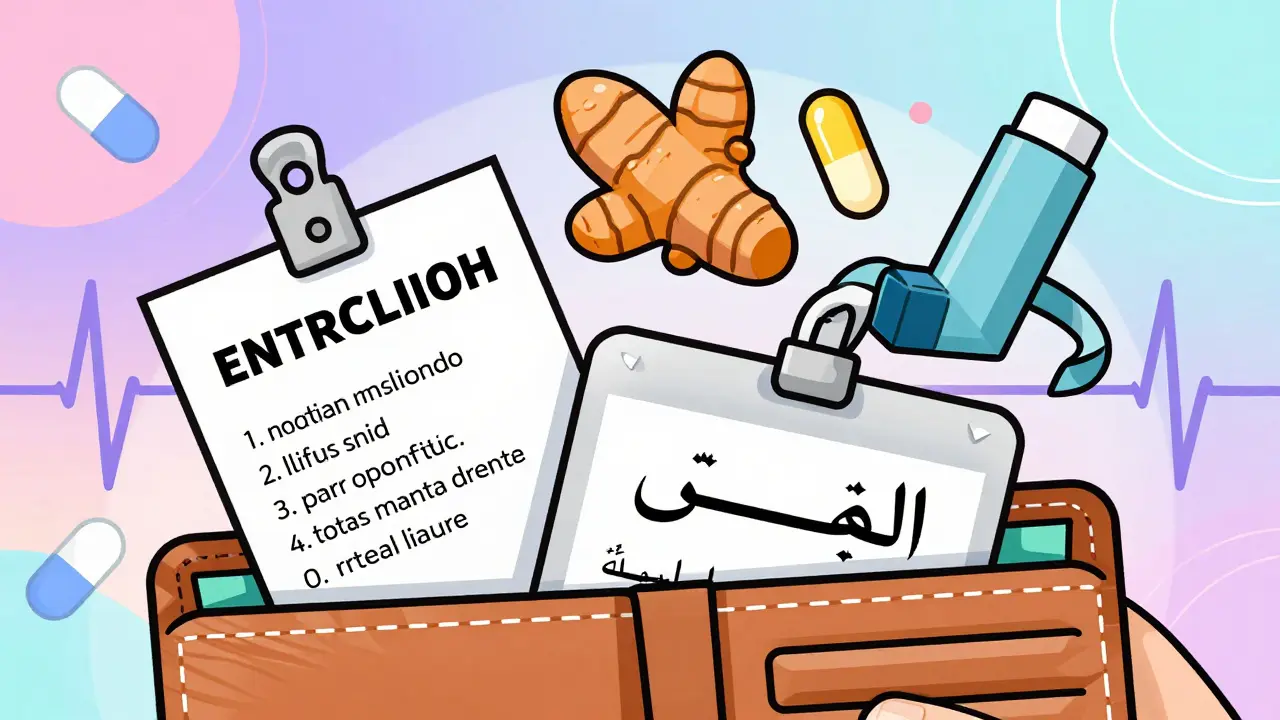
Google Translate won’t cut it. Medical terms don’t translate directly. “Amlodipine” might be written the same, but “for chest pain” could be mistranslated as “for heartburn.”
Here’s how to get it right:
- Use official templates from NPS MedicineWise or TPA. They’ve already been translated by pharmacists and linguists.
- If you need to translate your own list, ask your pharmacist. Many pharmacies in Australia and the U.S. have multilingual staff or access to professional translation services.
- Ask a trusted friend or family member who speaks the language fluently and understands medical terms. Don’t rely on someone who just learned the language.
- Double-check with a second person. Have someone read the translation back to you in your language to catch errors.
Also, consider cultural differences. In some cultures, people don’t take “prescription” drugs the same way. They might use herbal teas alongside pills. Make sure your list reflects your full routine-not just what’s on the bottle.
How to Carry Your List
A list on your phone isn’t useful if your battery dies. A paper copy in your bag might get lost. Here’s how to make sure it’s always there:
- Print two copies-one to keep in your wallet, one taped inside your passport or travel document.
- Take a photo-save it in your phone’s gallery with a clear label: “MEDS - EN, ES, VI.”
- Use the MedicineWise app-it lets you share your list via QR code. Emergency responders can scan it with their phone.
- Wear a medical ID bracelet-even a simple one that says “See Med List” with your emergency contact number.
Don’t forget to update it. Every time your doctor changes a dose, adds a new med, or stops one, update your list immediately. A 2022 study found that 78% of medication errors happened during transitions of care-like moving from hospital to home, or switching doctors.
What to Do in an Emergency
If you’re in trouble and can’t speak:
- Hand them your printed list immediately.
- Point to the section that says “Allergies” or “Blood Pressure.”
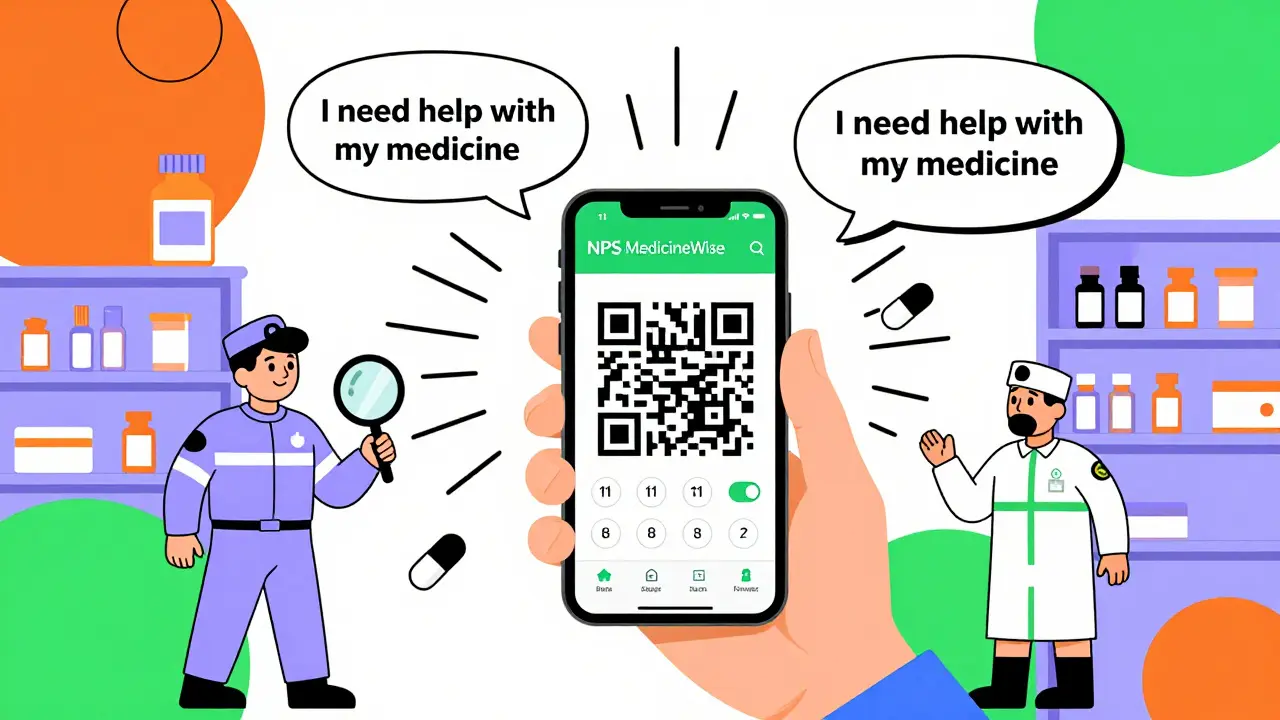
- If you have the British Red Cross phrasebook, show them the phrase: “I need help with my medicine.”
- If you’re using the MedicineWise app, say “Show my meds” or point to the QR code.
Emergency staff are trained to look for medication lists. If you’re in a country where they’re common, they’ll know what to do. If not, your list will still stand out-and it could save your life.
Common Mistakes to Avoid
People make the same errors over and over:
- Only translating one language-If you’re traveling to Spain and Mexico, you need Spanish. But if you’re visiting relatives in China, you need Mandarin or Cantonese. Don’t assume one translation covers all.
- Using outdated lists-If you stopped a med six months ago, cross it out. Outdated info causes dangerous confusion.
- Leaving out supplements-Turmeric, garlic pills, ginkgo-these aren’t “just vitamins.” They affect blood thinners, blood pressure meds, and anesthesia.
- Not testing it-Show your list to a native speaker and ask: “Would you understand this if you were in the ER?” If they hesitate, rewrite it.
And never rely on memory. Even if you’ve taken the same meds for 10 years, stress or illness can make you forget. Your list is your backup brain.
What’s Next? Digital Tools Are Getting Smarter
In 2024, the CDC added new languages to its resources-Amharic, Hmong, Karen, Oromo, and Tibetan-to better serve refugee communities. Google now shows translated medication info directly in search results for over 100 drugs. And by 2025, the American Pharmacists Association plans to release national standards for multilingual lists, including digital formats that sync with hospital systems.
But for now, the tools we have are enough-if you use them. You don’t need the latest app. You just need a list, in your language and others, that’s accurate, current, and easy to find.
Do I need a separate list for each language?
No. Use one master list with each medication clearly labeled in multiple languages side by side, or use separate printed copies for each language. The NPS MedicineWise app lets you toggle between languages in one digital list. The key is making sure each version has the same info-no missing meds or changed dosages.
Can I use Google Translate to make my list?
Don’t. Google Translate often gets medical terms wrong. For example, “take with food” might become “take with dinner,” which isn’t the same. “Daily” might translate as “every day,” but in some languages, that phrase implies a specific time. Always use official templates from trusted health organizations like NPS MedicineWise or the Tennessee Pharmacists Association.
What if my language isn’t covered?
If your language isn’t in the free lists, ask your pharmacist. Many pharmacies can print custom translations for a small fee or even for free. You can also use a professional medical translator through services like LanguageLine or Telehealth Interpreter Services. Avoid using friends or children unless they’re fluent in medical terminology. Accuracy matters more than speed.
Should I include herbal medicines and supplements?
Absolutely. Many herbal products interact with prescription drugs. For example, St. John’s Wort can make birth control or antidepressants ineffective. Turmeric can thin your blood. If you take it, write it down. Use the exact name you see on the bottle. If it’s a traditional remedy, write the local name and what it’s used for.
How often should I update my list?
Update it every time your doctor changes your meds-even if it’s just a dosage change. Keep your list current. Many people forget to update it after a hospital visit or a new prescription. A 2022 study showed that 78% of medication errors in emergencies happened because the list was outdated.


Kimberly Reker
January 31, 2026 AT 15:41Pro tip: Update it every time your pharmacy calls about a new script. I learned that the hard way after my doctor switched my blood pressure med and I forgot to update the list. Scary stuff.
Rob Webber
January 31, 2026 AT 20:40calanha nevin
February 1, 2026 AT 11:42Lisa McCluskey
February 3, 2026 AT 11:02Russ Kelemen
February 5, 2026 AT 01:20April Allen
February 6, 2026 AT 13:44Shawn Peck
February 7, 2026 AT 10:29Kathleen Riley
February 9, 2026 AT 00:58Beth Cooper
February 10, 2026 AT 12:26Donna Fleetwood
February 10, 2026 AT 15:39Melissa Cogswell
February 10, 2026 AT 18:27Diana Dougan
February 11, 2026 AT 16:35Shubham Dixit
February 12, 2026 AT 22:13Blair Kelly
February 14, 2026 AT 09:08Rohit Kumar
February 15, 2026 AT 17:01