You’ve likely heard the term "evergreening" thrown around in healthcare debates. It sounds like a buzzword, but it’s actually a specific legal and business strategy that keeps drug prices high long after the original invention should have entered the public domain. The core mechanism? Formulation patents on drug combinations. When a blockbuster drug’s primary patent expires, generic competitors rush to market. To stop them, big pharma companies don’t just invent new drugs; they tweak existing ones. They combine two known ingredients into a single pill, change the delivery method, or adjust the dosage ratio. Then, they file a new patent for this specific "combination." This article breaks down how these patents work, why regulators allow them, and what it means for your wallet.
The Strategy Behind Combination Patents
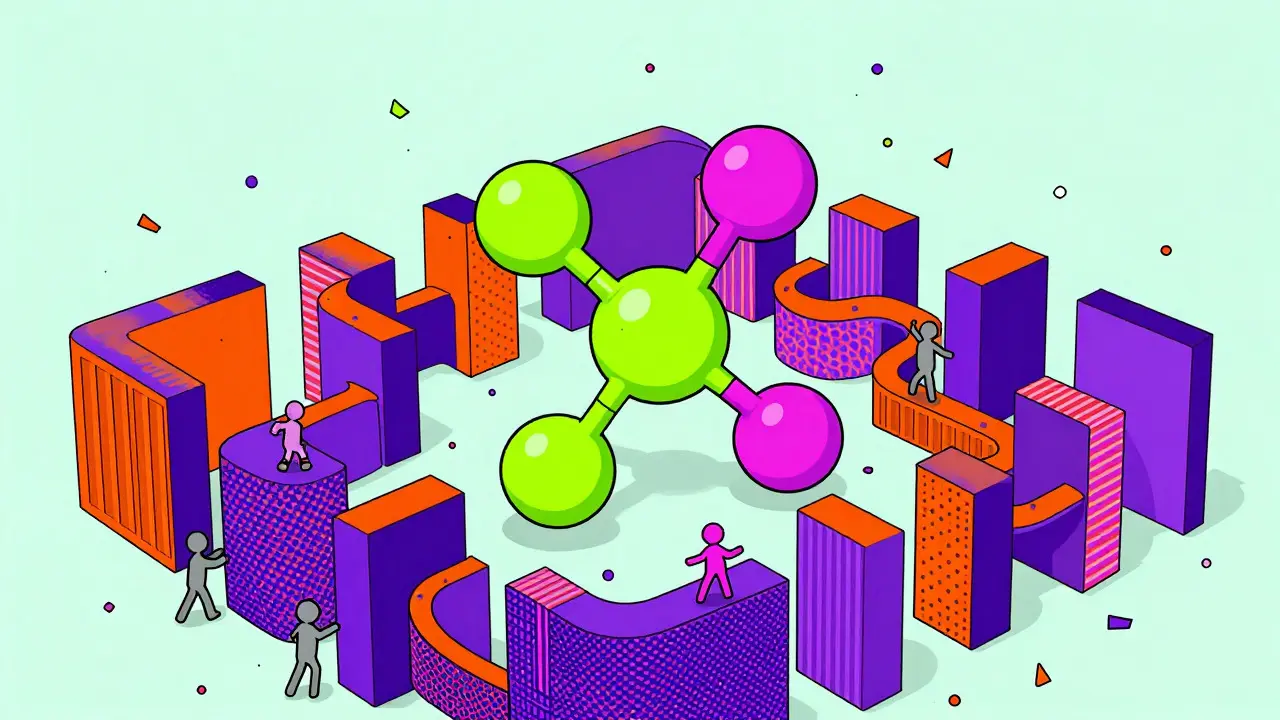
Think of a standard drug patent as a fence around a house. Once that fence falls (the patent expires), anyone can walk in and build their own version of the house (generic drug). But if you build a complex maze inside the yard with specific walls (formulation patents), you make it hard for others to replicate the exact experience without infringing on your new structures. This is often called a "patent thicket" or a "picket fence."
Under US law, specifically following the Hatch-Waxman Act of 1984, there’s a balance between encouraging innovation and allowing competition. The act allows for patent term extensions, but it also created the pathway for generics. Companies found a loophole: while you can’t patent the active ingredient again once it’s known, you can patent a novel way of combining it with another known ingredient, provided the combination shows unexpected results. For instance, if Drug A treats headaches and Drug B treats nausea, combining them isn’t automatically patentable. But if you prove that Drug A + Drug B at a precise 10mg:50mg ratio reduces side effects by 40% more than taking them separately, you might get a new patent. This extends market control by an average of 3 to 16 years beyond the initial expiration.
Overcoming the Obviousness Hurdle
The biggest enemy of formulation patents is the concept of "obviousness." In 2007, the Supreme Court ruled in KSR International Co. v. Teleflex Inc. that simply combining two known elements for a predictable result is obvious-and therefore not patentable. This decision raised the bar significantly. Now, pharmaceutical companies must provide concrete evidence that their combination does something surprising.
What counts as "surprising"? Usually, it’s statistical data showing superior efficacy, reduced toxicity, or improved bioavailability. For example, Roche’s Phesgo® combined trastuzumab and pertuzumab into a subcutaneous injection. While the individual drugs were known, the fixed-dose combination offered a massive convenience factor over separate IV infusions. This wasn’t just about convenience; the formulation had to be stable and effective in a new delivery format. If the FDA or patent examiners deem the combination "obvious," the patent gets rejected. This is why approval rates vary wildly by therapeutic area-oncology combinations see a 78% approval rate because the biological complexity makes "unexpected results" easier to prove, whereas CNS drugs face a steeper climb at 43%.
The Economic Impact: Evergreening vs. Innovation
Critics argue that this strategy is less about medical breakthroughs and more about protecting revenue streams. FTC Chair Lina Khan has pointed out that secondary patents on trivial changes can inflate U.S. drug prices by 17-23%. The argument is simple: if a company spends $2 billion developing a drug, they deserve protection. But if they spend $20 million tweaking the salt form or combining it with an existing generic to get five more years of monopoly pricing, are we paying for innovation or just legal maneuvering?
Data supports both sides. On one hand, Evaluate Pharma projects that combination patent strategies will protect $312 billion in annual revenue through 2028. These revenues fund the next wave of R&D. On the other hand, the Congressional Budget Office estimates that tightening rules on these secondary patents could save $150 billion in healthcare costs by 2028. The tension lies in distinguishing between genuine clinical improvements and "product hopping," where companies discontinue old formulations to force patients onto newly patented versions before generics can catch up.
| Patent Type | Primary Focus | Average Extension | Vulnerability to Challenge |
|---|---|---|---|
| Composition-of-Matter | The active ingredient itself | 12-14 years post-approval | Low (Hard to invalidate) |
| Formulation/Combination | Specific ratios, delivery methods, or API blends | 3-8 additional years | High (38% invalidation rate) |
| Method-of-Use | New indications or dosing schedules | Variable | Medium-High |
Regulatory Exclusivities: The Hidden Layer
It’s not just about patents. The FDA grants its own forms of protection called regulatory exclusivities, which run parallel to patent terms. Even if a patent is invalidated, these exclusivities can block generic entry. There are three main types relevant here:
- New Chemical Entity (NCE) Exclusivity: 5 years for entirely new molecules.
- New Clinical Investigation Exclusivity: 3 years for new formulations or indications. This is crucial for combination products. If you conduct new clinical trials to prove your combo works better, you get 3 years of protection from generic applications, regardless of patent status.
- Orphan Drug Exclusivity: 7 years for rare diseases.
These layers stack. A drug might have a composition patent expiring in 2025, but a formulation patent expiring in 2028, plus a 3-year regulatory exclusivity ending in 2029. This creates a "thicket" where generics must challenge multiple barriers simultaneously. According to the FDA, 42% of drugs approved between 2010 and 2020 received multiple overlapping exclusivity periods, delaying generic entry by an average of 4.7 years.
Challenges and Legal Battles
Generic manufacturers aren’t passive victims. They use the Paragraph IV certification process under Hatch-Waxman to challenge patents. If they win, they get 180 days of exclusive marketing rights themselves. Recent trends show success rates for these challenges rising to 45%, largely because courts are applying stricter standards to combination patents. The case of Revlimid® is a prime example. Generic makers successfully bypassed some patents by targeting non-patented indications, forcing the brand owner to defend each claim individually.
Another risk is "design-around." If a formulation patent specifies a precise ratio (e.g., 10mg:50mg), a generic competitor might try 9.8mg:51.2mg. If the patent claims are drafted poorly, this slight variation might not infringe. However, if the patent covers a range or emphasizes the critical nature of the ratio, the generic might still lose. Precision in drafting is everything. One patent attorney noted that vague claims lead to rejections, while hyper-specific claims can be easily designed around. Finding that sweet spot is where the real value lies.
Future Outlook: Tightening Screws
The era of easy evergreening may be winding down. Regulatory bodies are getting tougher. The FDA proposed rulemaking in 2024 requiring "clinical superiority evidence" for new formulations seeking exclusivity. Meanwhile, Congress is considering the Preserve Access to Affordable Generics Act, which would limit secondary patents to those demonstrating "meaningful clinical benefit." If passed, this could invalidate nearly 30% of current formulation patents.
Companies are adapting. Instead of minor tweaks, they’re investing in truly novel delivery systems, like pH-sensitive release technologies or biologic combinations that require complex manufacturing. These are harder to copy and offer clearer clinical benefits. The future favors quality over quantity in patent portfolios. Brands that rely solely on trivial combination patents will face faster generic erosion, while those with robust, clinically justified innovations will maintain stronger moats.
What is the difference between a composition patent and a formulation patent?
A composition patent protects the active pharmaceutical ingredient (API) itself-the molecule that does the healing. It’s the broadest protection. A formulation patent protects the specific way that API is packaged, combined with other ingredients, or delivered (e.g., a tablet vs. an injection, or a specific ratio of two drugs). Composition patents are harder to challenge, while formulation patents are narrower but can extend exclusivity when the core patent expires.
Why do pharmaceutical companies use combination patents?
To extend market exclusivity and protect revenue. When a blockbuster drug’s primary patent expires, generics enter, causing sales to drop by 80-90%. By securing patents on new combinations or formulations, companies can delay generic entry by several years, maintaining higher prices and recouping R&D investments.
Are combination patents always valid?
No. They face high scrutiny due to the "obviousness" standard established by KSR v. Teleflex. If combining two known drugs yields a predictable result, the patent may be invalidated. Data shows a 38% invalidation rate for combination patents, compared to 22% for primary composition patents.
How does the FDA regulate these patents?
The FDA lists eligible patents in the Orange Book. Companies must submit patent information within 30 days of issuance. Additionally, the FDA grants regulatory exclusivities (like 3 years for new clinical investigations) that operate independently of patents, creating layered barriers to generic entry.
What is "product hopping"?
Product hopping occurs when a manufacturer discontinues an older, unpatented formulation and aggressively markets a newly patented version just before generics arrive. This forces patients and insurers to switch to the protected product, effectively blocking generic substitution even if the new product offers little clinical advantage.


Eryn Manchego
August 31, 2026 AT 04:12love this breakdown of the patent thicket strategy it really highlights how formulation patents act as a secondary fence around the active ingredient preventing generic entry through clever ratio adjustments and delivery method tweaks
the data on oncology approval rates being so much higher than cns drugs is fascinating because it shows how biological complexity provides cover for what might otherwise seem like obvious combinations to regulators
Crystal Torres
September 2, 2026 AT 02:13The distinction between regulatory exclusivity and patent protection is crucial yet often misunderstood by the general public. It is imperative to recognize that even if a court invalidates a formulation patent, the FDA's New Clinical Investigation Exclusivity can still block generic applications for three years. This dual-layer barrier creates significant uncertainty for market entrants and consumers alike.
Patrick van der Velde
September 3, 2026 AT 09:27It is utterly repugnant to witness these pharmaceutical conglomerates engaging in such brazen rent-seeking behavior under the guise of innovation. They are not inventing; they are merely shuffling deck chairs on the Titanic of their own greed while patients suffer.
One must look at the KSR v Teleflex ruling which was supposed to curb this nonsense but has been systematically undermined by lawyers who draft claims with surgical precision to avoid the obviousness hurdle. The arrogance of claiming a new monopoly based on a trivial change in salt form or dosage ratio is an insult to the very concept of intellectual property rights which were designed to promote progress not to stifle it for corporate gain.
Vivek Chaturvedi
September 4, 2026 AT 04:58these companies have no moral compass they exploit every loophole possible to keep prices high while doing minimal actual research into new molecules
it is sad to see how legal maneuvering trumps patient welfare in this system where money speaks louder than health outcomes
Lolo Del
September 4, 2026 AT 09:21Hey there folks great read here just wanted to jump in with some perspective from the trenches of pharma marketing
While the critics scream about evergreening you have to understand the R&D costs involved developing a drug isn't cheap and if you don't protect your investment nobody will take the risk to make life saving meds for rare diseases
Also product hopping gets a bad rap but sometimes moving to a subcutaneous injection like Phesgo is genuinely better for patient quality of life than sitting in an IV chair for hours
We need to balance affordability with sustainability otherwise we'll stop seeing breakthroughs altogether
Tobi Oyewole
September 4, 2026 AT 12:10I appreciate the nuanced approach taken in this article regarding the tension between innovation incentives and consumer access
From a philosophical standpoint one must consider whether the primary purpose of patent law is to reward effort or to ensure societal benefit
If the latter holds true then the current system seems skewed towards protecting capital rather than enhancing human well-being
However I respect the boundary that allows companies to recoup investments provided that the clinical superiority is genuine and not merely a marketing ploy disguised as science
We should strive for a middle ground where transparency in clinical trials ensures that combination patents deliver real value rather than just extending revenue streams
Sarah Kinch
September 5, 2026 AT 23:37honestly its all rigged anyway
they just tweak stuff and call it new science to keep us paying more for old drugs
its lazy and toxic and i dont care about the nuance anymore
fred eden
September 6, 2026 AT 08:37This is such an important topic! 🌟 It breaks my heart to think about people struggling to afford meds when the core invention is already off-patent. 😢
But I also want to be fair to the scientists working hard in labs. 💪 Sometimes those "tweaks" actually help people take their medicine easier which is huge for compliance! ❤️
Let's hope the regulations get tighter so we get both innovation AND affordability. 🙏✨
Pearl Richardson
September 8, 2026 AT 06:41One cannot ignore the suspicious timing of these patent filings. 🕵️♀️ It appears that the regulatory bodies are captured by the very industries they are meant to oversee. 🚫🏛️
The stacking of exclusivities is not accidental but a calculated move to delay competition indefinitely. 📉💸 We are witnessing a systematic erosion of public trust in healthcare institutions. 🔒👁️
larry williams
September 9, 2026 AT 08:43I believe that while the concerns about evergreening are valid we must also recognize the incredible work being done to improve patient outcomes through better delivery systems and combination therapies that reduce side effects
It is easy to criticize the business side of medicine but we should remember that without these financial protections many promising treatments would never reach the market due to the sheer cost and risk of development
Let's focus on supporting policies that encourage genuine clinical improvement rather than just penalizing companies for trying to stay solvent in a complex global market
We can do this together by advocating for transparency and better pricing models that benefit everyone involved in the healthcare ecosystem
Stephen Horn
September 10, 2026 AT 06:37The assertion that these strategies are mere loopholes ignores the sophisticated legal frameworks governing intellectual property. 🧐 One must acknowledge that the Supreme Court's stance on obviousness is applied with varying degrees of rigor depending on the judicial district and the specific technical nuances of each case. ⚖️
Furthermore the argument that these patents inflate prices by 17-23% lacks robust longitudinal data accounting for inflation and manufacturing complexities in biologics. 📊 The conspiracy theorists often overlook the fact that many of these combination therapies address unmet medical needs that single-agent therapies simply could not resolve effectively. 🧬