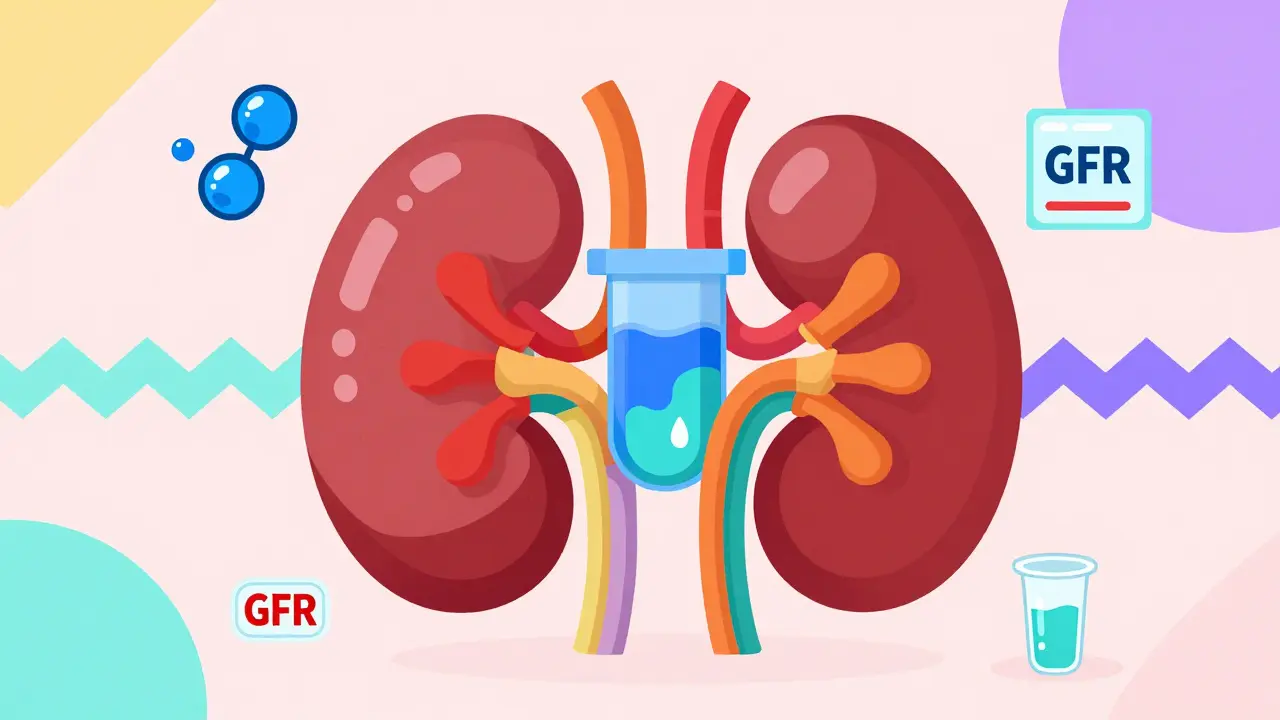
When your doctor orders a kidney function test, it’s not just another blood draw or urine sample. It’s a quiet but powerful way to catch problems before you even feel sick. Most people don’t realize their kidneys are working overtime every minute-filtering about 120 to 150 quarts of blood daily to produce 1 to 2 quarts of urine. That’s a lot of work. And when those filters start to fail, the signs aren’t always obvious. That’s where creatinine, GFR, and urinalysis come in. These three tests form the backbone of kidney health checks, and knowing what they measure-and what they don’t-can help you understand your results and ask the right questions.
What Creatinine Tells You (And What It Doesn’t)
Creatinine is a waste product your muscles make as they break down energy. Your kidneys filter it out of your blood and send it into your urine. If your kidneys aren’t working well, creatinine builds up in your bloodstream. That’s why doctors look at serum creatinine levels to get a clue about kidney function.
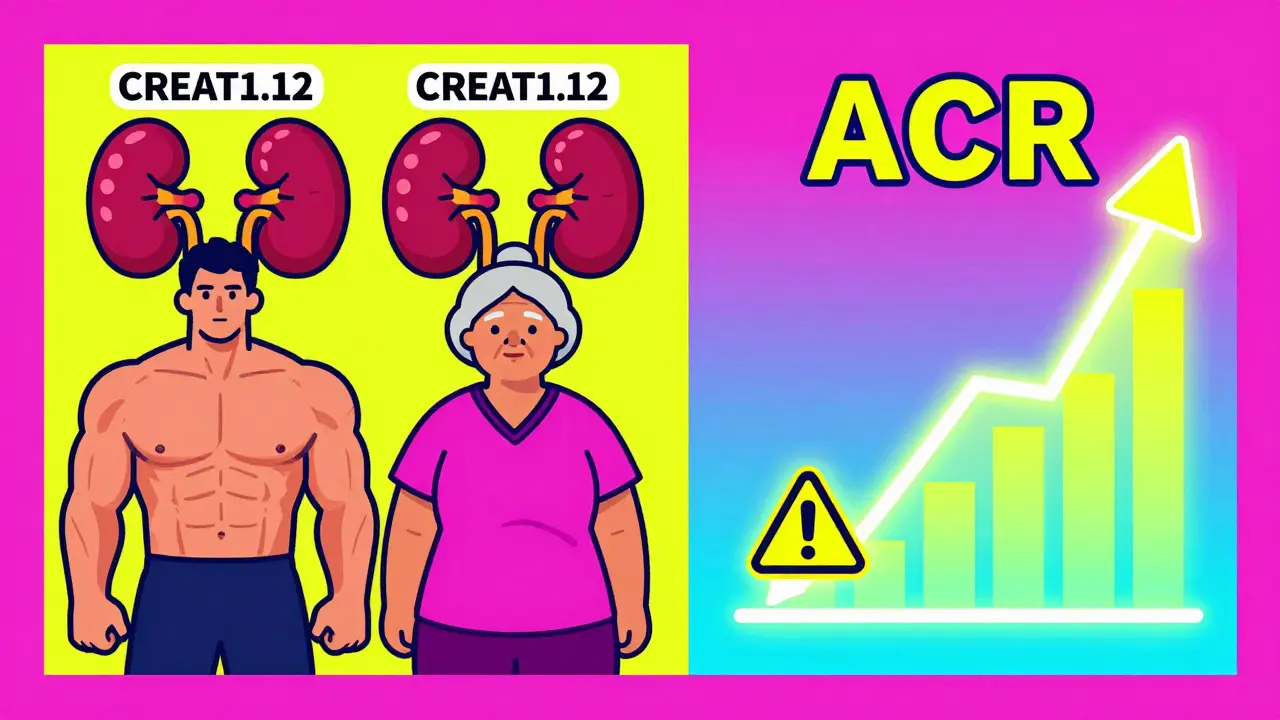
But here’s the catch: creatinine doesn’t rise until you’ve already lost about half your kidney function. That means it’s a late warning sign. Two people can have the same creatinine level, but one might be a 70-year-old woman with low muscle mass, and the other a 30-year-old bodybuilder. Their actual kidney function could be wildly different. That’s why creatinine alone isn’t enough. It’s a starting point, not the full story.
Normal creatinine levels vary by age, sex, and muscle mass. For adult men, it’s usually 0.7 to 1.3 mg/dL. For adult women, it’s 0.6 to 1.1 mg/dL. But numbers alone don’t tell you if your kidneys are failing. That’s where GFR comes in.
Understanding GFR: The Real Measure of Kidney Filtering Power
Glomerular Filtration Rate, or GFR, is the gold standard for measuring how well your kidneys filter blood. It’s not directly measured in most clinics-it’s calculated. And that calculation uses your creatinine level, along with your age, sex, and sometimes race, to estimate how many milliliters of blood your kidneys clean per minute.
The most accurate formula used today is the CKD-EPI equation, introduced in 2009. It replaced the older MDRD formula because it’s more precise, especially for people with normal or near-normal kidney function. Most labs now report eGFR (estimated GFR) right alongside your creatinine result.
Here’s what the numbers mean:
- 90 or higher: Normal kidney function. Even if you have mild damage (like early diabetes), your kidneys are still filtering well.
- 60-89: Mildly reduced function. Could be normal for older adults, but needs monitoring.
- 30-59: Moderately reduced. This is where you start seeing symptoms like fatigue or swelling.
- 15-29: Severely reduced. You’re approaching kidney failure.
- Below 15: Kidney failure. Dialysis or transplant becomes necessary.
But GFR isn’t perfect. It can be misleading if you’re very muscular, very overweight, pregnant, under 18, or have a condition that affects muscle mass. That’s why some doctors now use cystatin C-a different protein filtered by the kidneys-as an alternative or backup. It’s less affected by muscle mass and gives a clearer picture in tricky cases.
Urinalysis: The Silent Signaler of Kidney Trouble
While blood tests show how well your kidneys are filtering, urinalysis shows what they’re letting through. Healthy kidneys hold onto proteins like albumin. When they’re damaged, even tiny amounts leak into the urine. That’s called albuminuria, and it’s often the first sign of kidney disease-sometimes appearing before creatinine even starts to rise.
Doctors don’t use old-school dipstick tests anymore. Those colorful strips that change color are too unreliable. Instead, they use the Albumin-to-Creatinine Ratio (ACR), a precise urine test that measures how much albumin is in your urine compared to creatinine. It’s done on a single early-morning sample, no 24-hour collection needed.
Here’s how ACR results break down:
- Less than 3 mg/mmol: Normal
- 3 to 70 mg/mmol: Microalbuminuria-early kidney damage
- Over 70 mg/mmol: Macroalbuminuria-more advanced damage
If your ACR is high, your doctor will likely repeat the test. One high result could be from dehydration, infection, or even intense exercise. But if it’s high on two out of three tests over three months, that’s a strong signal of chronic kidney disease.
Urinalysis also checks for blood, sugar, or infection. Blood in the urine (hematuria) can point to kidney stones, infection, or tumors. Sugar in the urine usually means uncontrolled diabetes. Both are red flags that need follow-up.
Why You Need Both Blood and Urine Tests
Here’s the truth: you can’t rely on just one test. Someone might have a normal creatinine and GFR but still have significant protein in their urine. That’s early kidney damage. Or someone might have high creatinine because they’re a bodybuilder, but their urine test shows no protein-meaning their kidneys are fine.
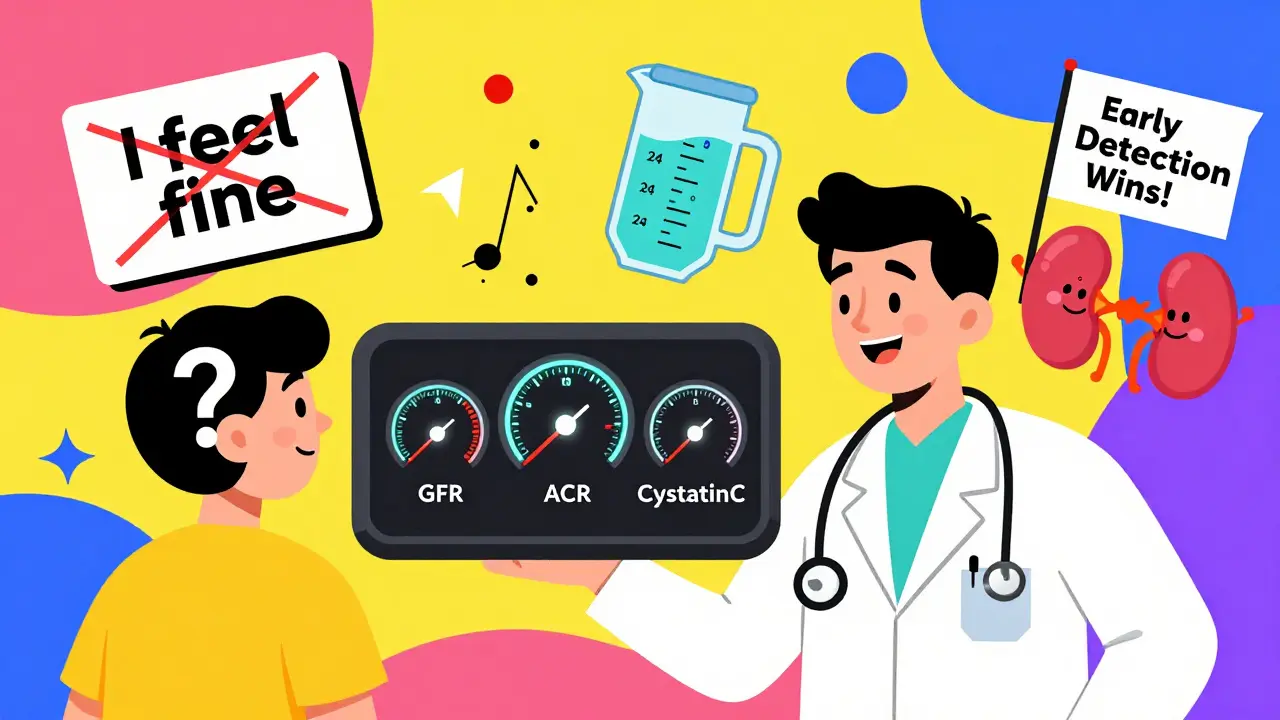
The UK Kidney Association and the American Kidney Fund both agree: the best way to screen for kidney disease is to check both eGFR and ACR. This two-pronged approach catches more problems earlier. That’s why people with diabetes, high blood pressure, heart disease, or a family history of kidney failure are told to get tested every year-even if they feel fine.
Think of it like checking your car. You don’t just look at the oil light. You check the brakes, the tires, the fluids. Kidneys work the same way. One test gives you part of the picture. Two tests give you the whole dashboard.
Who Should Get Tested and How Often
You don’t need to be sick to need a kidney test. The CDC recommends everyone get a basic metabolic panel-including creatinine and eGFR-at least once a year as part of a routine checkup. But if you have risk factors, you need more frequent testing:
- Diabetes: Test eGFR and ACR at least once a year. Some doctors test every 6 months if blood sugar is poorly controlled.
- High blood pressure: Test annually. Uncontrolled hypertension is the second leading cause of kidney failure.
- Heart disease or stroke history: These conditions often go hand-in-hand with kidney damage.
- Family history of kidney failure: Genetic risk means earlier and more regular screening.
- Age over 60: Kidney function naturally declines with age. Monitoring helps catch abnormal drops.
Even if you’re healthy, a single test can reveal something you didn’t know. A 52-year-old woman with no symptoms had a routine blood test that showed an eGFR of 58. Her ACR was 45 mg/mmol-both signs of early kidney disease. She had undiagnosed high blood pressure. After starting treatment, her kidney numbers improved within six months.
What Happens If Your Results Are Abnormal
Don’t panic. An abnormal result doesn’t mean you have kidney failure. It means you need to dig deeper. Your doctor might:
- Repeat the tests to confirm
- Order imaging like an ultrasound to check kidney size or structure
- Check for other conditions like thyroid disease or autoimmune disorders
- Refer you to a nephrologist (kidney specialist) if damage is moderate to severe
Treatment often starts with lifestyle changes: lowering salt, controlling blood pressure, managing blood sugar, quitting smoking, and avoiding NSAIDs like ibuprofen. Medications like ACE inhibitors or ARBs are commonly prescribed-they don’t just lower blood pressure; they protect the kidneys by reducing protein leakage.
And here’s the good news: early-stage kidney disease can often be slowed or even reversed. The key is catching it before too much damage is done. That’s why these tests matter.
Common Myths About Kidney Tests
Myth: “I feel fine, so my kidneys must be okay.”
Most kidney disease has no symptoms until it’s advanced. By the time you feel tired, swollen, or nauseous, you may have lost 70% of your kidney function.
Myth: “Only people with diabetes need these tests.”
While diabetes is the top cause, high blood pressure, obesity, and aging are big contributors too. One in three adults in the U.S. has high blood pressure. Many don’t even know it.
Myth: “A normal creatinine means my kidneys are fine.”
As we’ve seen, creatinine lags behind. You can have normal creatinine but still have protein in your urine-that’s early warning.
Myth: “I have to collect urine for 24 hours.”
That’s outdated. The ACR test uses a single early-morning sample. No special containers, no timing, no hassle.
What You Can Do Right Now
If you’ve never had a kidney function test:
- Ask your doctor for a basic metabolic panel during your next checkup. It includes creatinine and eGFR.
- Request a urine ACR test-especially if you have diabetes, high blood pressure, or are over 50.
- Don’t wait for symptoms. Kidney disease doesn’t knock first.
- Keep your blood pressure under 130/80 and your blood sugar in target range if you’re diabetic.
- Stay hydrated, limit salt, avoid long-term NSAID use, and don’t smoke.
Your kidneys don’t ask for much. Just a little attention, and they’ll keep working for you for decades.
What does a high creatinine level mean?
A high creatinine level usually means your kidneys aren’t filtering waste as well as they should. But it’s not always a sign of disease. Muscle mass, dehydration, or certain medications can raise creatinine too. That’s why doctors look at it along with eGFR and urinalysis to get the full picture.
Can I improve my GFR?
Yes, in early stages. Controlling blood pressure, managing diabetes, losing weight, reducing salt, and avoiding kidney-damaging drugs like NSAIDs can help stabilize or even improve your GFR. The earlier you act, the better the outcome.
Is a urine test more important than a blood test for kidneys?
Both are essential. Blood tests (eGFR) show how well your kidneys filter. Urine tests (ACR) show if they’re leaking protein-often the earliest sign of damage. You need both to catch kidney disease early.
Why is cystatin C used instead of creatinine sometimes?
Cystatin C is a protein made by all cells and filtered by the kidneys. Unlike creatinine, it’s not affected by muscle mass, diet, or age as much. So if you’re very muscular, very thin, pregnant, or under 18, cystatin C can give a more accurate estimate of kidney function than creatinine alone.
How often should I get tested if I have diabetes?
At least once a year. If your blood sugar is poorly controlled or you already have signs of kidney damage, your doctor may recommend testing every 6 months. Early detection is the best way to prevent kidney failure.




Candice Hartley
January 26, 2026 AT 20:09Just got my ACR back - 42 mg/mmol. No symptoms, no clue. Thanks for explaining this so clearly. 🙏
Harry Henderson
January 27, 2026 AT 07:22THIS. Why do doctors still act like creatinine is the gospel? I'm 32, lift heavy, and my creatinine was 1.4 - they almost sent me to a nephrologist. Turned out my GFR was 92 and ACR was 1.2. My muscles are just that damn efficient. Stop overreacting to numbers without context.
suhail ahmed
January 27, 2026 AT 10:29Man, I come from a family where kidney disease wiped out three uncles before 50. I started getting tested at 28 - eGFR and ACR every year. One year, my ACR jumped to 28. No symptoms. No high BP. Just... quietly creeping damage. Started cutting salt, walking daily, and ditched soda. Two years later? Back to 4. Kidneys are silent warriors. Treat 'em right, they'll carry you till 90. Don't wait till you're swollen and tired.
Also, cystatin C? If you're lean or over 60, ask for it. Creatinine lies to muscle folks. I've seen too many South Asians with normal creatinine but busted kidneys because no one checked ACR. It's not fancy - it's essential.
astrid cook
January 27, 2026 AT 20:30Everyone’s so obsessed with tests. Meanwhile, Big Pharma is laughing all the way to the bank. They don’t want you to know that kidney damage can be reversed with fasting, magnesium, and avoiding processed foods. You think they care about your ACR? They care about your monthly prescriptions.
Andrew Clausen
January 28, 2026 AT 11:48Correction: The CKD-EPI equation does not include race in its current 2021 revision. The previous version did, but the updated guideline removed it due to racial bias concerns. The post is outdated on this point. Always verify the version of the formula your lab uses. Accuracy matters.
April Williams
January 29, 2026 AT 03:32My doctor told me my GFR was 57. I asked why he didn't test cystatin C. He said it's 'not standard.' I looked it up. Turns out it's in the guidelines since 2018. So now I'm going to a different doctor. If your provider is still using 2009 protocols, they're not keeping up. You deserve better.
Anjula Jyala
January 30, 2026 AT 14:32ACR is the only test that matters. Creatinine is garbage for anyone under 40 or over 70. GFR is a calculation based on garbage. Urine protein is the real red flag. No urine test no diagnosis. Period. Stop wasting time on blood panels alone. If you're diabetic you're already at risk. Test ACR every 6 months. Done.
Murphy Game
February 1, 2026 AT 12:44They’re hiding something. Why does the CDC say ‘everyone’ should get tested but insurance won’t cover cystatin C unless you’re on dialysis? Why is ACR only free if you’re diabetic? I’ve seen the charts - kidney disease spikes after 50, but they only screen the poor. Coincidence? Or is this about profit margins?
Kirstin Santiago
February 2, 2026 AT 06:09Thank you for writing this. I’m 68, diabetic, and I didn’t realize my ACR was a bigger deal than my creatinine. I thought ‘normal’ creatinine meant I was fine. Now I’m getting a repeat ACR next week. And I’m telling my sister to do the same. Small steps. Big impact.