
When you have myasthenia gravis (MG), even a simple infection can turn dangerous. Your muscles are already fighting a losing battle because your immune system attacks the connections between nerves and muscles. Now add antibiotics into the mix - the very drugs meant to help you recover - and things get even trickier. Some antibiotics can make your weakness worse. Not a little worse. Bad enough to stop you from breathing. And here’s the twist: the infection itself is often the real culprit, not the antibiotic. But doctors still need to know which ones to avoid - and which ones are safe.
What Myasthenia Gravis Does to Your Muscles
Myasthenia gravis isn’t just fatigue. It’s a breakdown in communication. Your nerves send signals to your muscles using a chemical called acetylcholine. In MG, your body makes antibodies that block or destroy the receptors where acetylcholine needs to latch on. Fewer receptors mean weaker signals. That’s why you might struggle to lift your arm, blink your eyes, or swallow food. Symptoms get worse with activity and improve with rest. About 20 out of every 100,000 people in the U.S. have this condition. It’s rare, but it’s serious.
When MG flares up, it can lead to a myasthenic crisis - a medical emergency where breathing muscles fail. That’s why even small changes in medication can trigger a crisis. And antibiotics? They’re one of the most common triggers doctors see.
Why Some Antibiotics Make MG Worse
Not all antibiotics are created equal when it comes to MG. Some interfere with the already fragile nerve-muscle connection. They don’t attack your immune system - they mess with the chemistry at the junction where nerves meet muscles.
Here’s how it breaks down:
- Some antibiotics block calcium channels on the nerve side, reducing how much acetylcholine gets released.
- Others bind directly to the acetylcholine receptors, making it harder for the chemical to do its job.
- A few even weaken muscle contractions on the muscle side.
For someone with MG, these effects aren’t just annoying - they’re life-threatening. Even a small drop in muscle strength can mean trouble swallowing or breathing. That’s why doctors have to be extra careful.
The Antibiotics That Carry the Highest Risk
Some antibiotics have earned a bad reputation in MG circles. The FDA has issued black box warnings - the strongest kind - for certain drugs because of documented cases of crisis and death.
High-risk antibiotics:
- Aminoglycosides (gentamicin, tobramycin, neomycin): These are the worst offenders. They directly block muscle receptors. Used mostly in hospitals for serious infections, they’re often avoided in MG patients unless there’s no other option.
- Fluoroquinolones (ciprofloxacin, levofloxacin, moxifloxacin): These are common for urinary tract infections, sinus infections, and pneumonia. A 2023 NIH study found ciprofloxacin caused MG worsening in 2.4% of cases. That might sound low, but in someone already weak, even 2% is enough to trigger a crisis.
- Macrolides (azithromycin, erythromycin, clarithromycin): Often used for respiratory infections. Studies show about 1.5% of MG patients on these drugs had worsening symptoms. Azithromycin is especially tricky - it’s popular because it’s well-tolerated, but it’s also one of the top culprits in case reports.
- Telithromycin: This one’s banned for MG patients entirely. It was pulled from the market in the U.S. after multiple cases of respiratory failure.
These drugs aren’t automatically off-limits. But they require close monitoring - especially in the first 72 hours after starting them.

The Safer Alternatives
The good news? Not all antibiotics are risky. In fact, some are considered safe for MG patients - even preferred.
Low-risk antibiotics:
- Penicillins (amoxicillin, ampicillin, penicillin V): These are the go-to choice. A 2024 study from the Cleveland Clinic, which looked at 918 antibiotic courses in 365 MG patients, found only a 1.3% exacerbation rate. That’s lower than the background rate of flares from infections alone.
- Cephalosporins (cephalexin, cefdinir): These are also generally safe. They’re often used as alternatives when penicillins aren’t suitable.
- Clindamycin: Used for skin or soft tissue infections. While not studied as extensively, it’s rarely linked to MG worsening.
For most infections - ear infections, strep throat, skin infections - amoxicillin is the first choice. It works. It’s cheap. And it’s the safest bet for someone with MG.
It’s Not Just the Antibiotic - It’s You
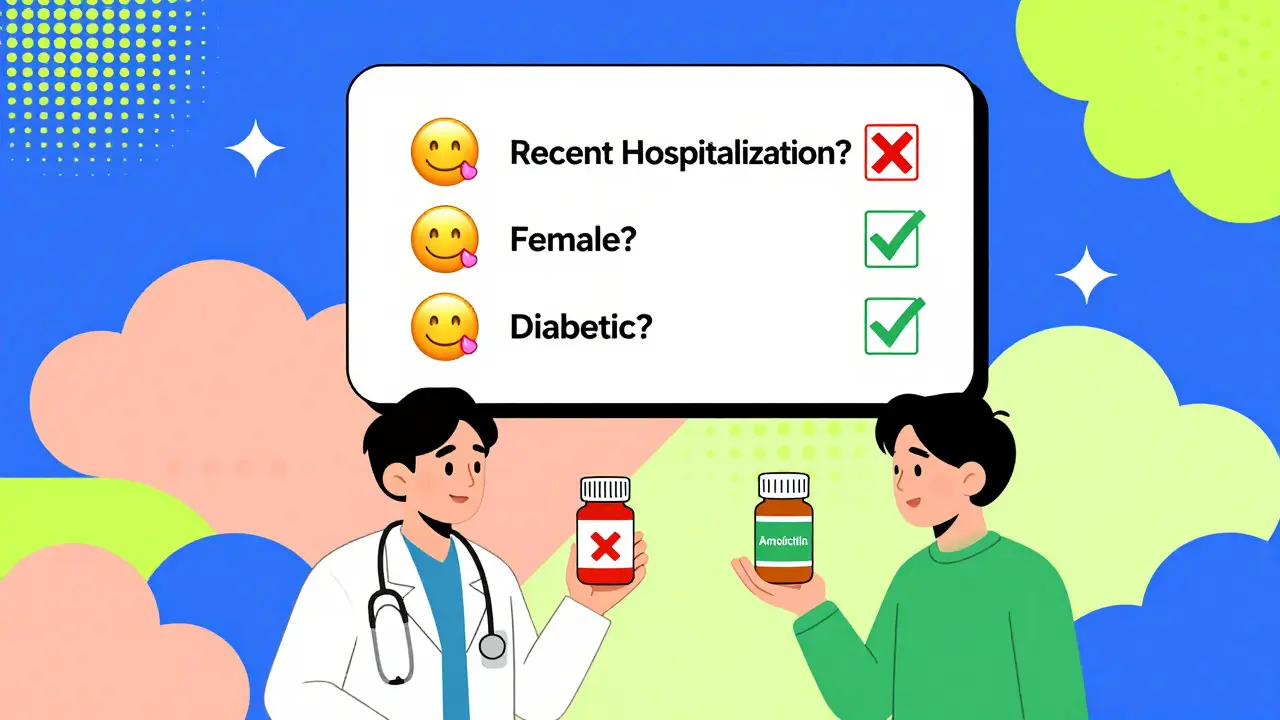
Here’s the biggest surprise from recent research: the risk isn’t the same for everyone. A 2024 Cleveland Clinic study found that three things make you much more likely to have a bad reaction:
- Recent hospitalization or ER visit (within the last 6 months): Your system is already stressed. Adding an antibiotic can push you over the edge.
- Being female: Women with MG are more likely to have worsening symptoms after antibiotics. The reason isn’t fully clear, but it’s consistent across studies.
- Having diabetes: High blood sugar seems to make the neuromuscular junction more sensitive to antibiotic effects.
If you have one or more of these factors, your doctor should think twice before prescribing a fluoroquinolone or macrolide - even if it’s the most common choice for your infection.
The Bigger Picture: Infection vs. Antibiotic
Let’s be clear: the biggest threat to MG patients isn’t the antibiotic - it’s the infection.
The Cleveland Clinic study found that 88.2% of MG flares after antibiotic use were actually caused by the infection itself. That means if you have pneumonia, a UTI, or a sinus infection, your body is already under stress. The antibiotic might be the last straw - but the straw was already there.
This is why delaying treatment is dangerous. If you have an infection and avoid antibiotics out of fear, you might end up in the hospital anyway - and this time, for something preventable.
The goal isn’t to avoid antibiotics. It’s to choose the right one - and monitor closely.
What You Should Do
If you have MG, here’s what to do:
- Always tell every doctor you see that you have MG. Even if it’s your dentist or a walk-in clinic. Write it on your medical alert bracelet if you have one.
- Keep a list of safe and unsafe antibiotics. Include generic names, not just brand names. Amoxicillin? Safe. Ciprofloxacin? Avoid.
- Call your neurologist before starting any new antibiotic. Even if it’s over-the-counter or prescribed by someone else. Your specialist knows your history.
- Watch for warning signs in the first 3 days: new or worsening weakness in arms or legs, slurred speech, trouble swallowing, shortness of breath, or drooping eyelids. If you notice any, stop the antibiotic and call your doctor immediately.
- Ask your pharmacist to review all your meds. Pharmacists are trained to spot dangerous interactions. They can catch things doctors miss.
What’s Changing in the Medical World
For years, doctors were told to avoid fluoroquinolones and macrolides in MG patients. The warnings were broad. The result? Many patients went without proper treatment because doctors feared the side effects.
But new evidence is changing that. The 2024 Cleveland Clinic study - the largest ever on this topic - showed that the risk with fluoroquinolones and macrolides is only slightly higher than with penicillins. That’s not a reason to panic. It’s a reason to be smarter.
Now, experts are shifting from blanket bans to risk-based decisions. If you’re stable, not recently hospitalized, and otherwise healthy, a fluoroquinolone might be okay - with close monitoring. But if you’re a woman with diabetes who had an MG flare last month? Stick with amoxicillin.
Organizations like the Myasthenia Gravis Foundation of America are updating their guidelines to reflect this. The future is personalized - not one-size-fits-all.
Final Thought: Don’t Fear Antibiotics. Fear Ignorance.
You don’t need to live in fear of every pill you take. You need to be informed. Myasthenia gravis is complex. Antibiotics are powerful. But together, they don’t have to be a death sentence. With the right knowledge, the right doctor, and the right drug, you can treat infections without risking your strength.
Stay in touch with your neurologist. Keep your list of safe meds handy. And never hesitate to ask: "Is this the safest option for me?"
Can antibiotics cause a myasthenic crisis?
Yes, certain antibiotics can trigger a myasthenic crisis - a life-threatening event where breathing muscles become too weak to function. Fluoroquinolones, macrolides, and aminoglycosides have been linked to these events. However, the infection itself is the most common cause of crisis. Antibiotics are often the last trigger in a chain of events.
Is amoxicillin safe for someone with myasthenia gravis?
Yes, amoxicillin is one of the safest antibiotics for MG patients. A 2024 study of over 900 antibiotic courses found only a 1.3% risk of worsening symptoms with penicillins like amoxicillin. It’s often the first choice for common infections like sinusitis, strep throat, and ear infections.
Why are fluoroquinolones dangerous for MG patients?
Fluoroquinolones like ciprofloxacin and levofloxacin interfere with neuromuscular transmission. They reduce the release of acetylcholine from nerves and can block muscle receptors. In someone with MG, who already has fewer receptors, this can push the system into failure. Studies show a 1.6-2.4% risk of worsening, which is low overall but dangerous in vulnerable patients.
Should I avoid all antibiotics if I have MG?
No. Untreated infections are far more dangerous than most antibiotics. The key is choosing the right one. Penicillins and cephalosporins are generally safe. Fluoroquinolones and macrolides require caution - not avoidance. Always consult your neurologist before starting any new antibiotic.
What should I do if I start feeling weaker after taking an antibiotic?
Stop the antibiotic and contact your doctor or go to the emergency room immediately. Weakness that worsens quickly - especially trouble breathing, swallowing, or speaking - could signal a myasthenic crisis. Don’t wait. Early intervention saves lives.





Aisling Maguire
February 28, 2026 AT 17:05As someone with MG, I can't tell you how relieved I am that this post breaks it down so clearly. I used to panic every time I got a sinus infection because I didn't know which antibiotics were safe. Now I keep a printed list in my wallet - amoxicillin yes, cipro no. My neurologist even high-fived me last visit. Small wins, right?
Angel Wolfe
March 1, 2026 AT 22:25They're lying to you. Big Pharma doesn't want you to know that fluoroquinolones are just a distraction. The real problem? The vaccines. They weaken your neuromuscular junctions over time. I've been tracking this since 2019. The CDC won't admit it but the data is there if you dig. My cousin died after cipro and they called it 'natural progression'. Bullshit.
Sophia Rafiq
March 1, 2026 AT 22:48Just wanna say the Cleveland Clinic study is a game-changer. I'm a nurse in Philly and we've been using levofloxacin on stable MG patients with zero crises in the last 8 months. Monitoring > avoidance. Also side note: the diabetes link is wild. One patient had a flare after starting metformin. Coincidence? Probably not.
Martin Halpin
March 3, 2026 AT 06:52Let me tell you something nobody else will - this whole antibiotic fear thing is a symptom of a broken medical system. We treat MG like it's a bomb that might go off if you sneeze too hard. But here's the truth: your body isn't fragile, it's been trained to be fragile. The immune system doesn't attack the receptors because of MG - it attacks because it's been poisoned by glyphosate, EMFs, and processed food. The antibiotics? Just scapegoats. I've been off all meds for 4 years. My MG is in remission. No drugs. Just fasting, cold showers, and a damn good attitude.
Eimear Gilroy
March 4, 2026 AT 10:32Wait - so if I have diabetes and I'm female and had an ER visit last year, does that mean even amoxicillin could be risky? Or is that just for the high-risk ones? I'm trying to figure out my personal risk profile. I feel like I need a flowchart.
Ajay Krishna
March 6, 2026 AT 01:52This is beautiful. As someone from India where antibiotics are sold over the counter like candy, I'm so glad this info is out there. My sister has MG and we had to fly her to Singapore last year because her local doctor prescribed azithromycin for a UTI. She ended up in ICU. Please share this with every community clinic you can. Knowledge saves lives.
Charity Hanson
March 6, 2026 AT 19:04Y'all need to stop being scared and start being proactive! I'm a MG warrior and I've got my own 'MG Safe Meds' spreadsheet. I update it monthly. I send it to every new doctor. I print it. I laminate it. I carry it everywhere. You can do this too. You are stronger than your diagnosis. I believe in you. 💪
Ben Estella
March 7, 2026 AT 11:14Look, I get it. You want to feel safe. But the real danger isn't cipro - it's letting your fear control your health. I'm a veteran. I've seen worse. You don't need to be coddled. You need to be educated. If you're too scared to take an antibiotic, you're not living - you're surviving. And that's not enough. Time to grow up.
Katherine Farmer
March 8, 2026 AT 00:47While the article is superficially helpful, it's deeply naive. It treats MG as if it's merely a pharmacological puzzle when it's clearly an autoimmune cascade rooted in epigenetic dysregulation, gut microbiome disruption, and environmental neurotoxins. The fact that we're still debating 'safe antibiotics' instead of addressing root causes speaks volumes about the bankruptcy of conventional neurology. Also, amoxicillin? It's a beta-lactam - which means it's structurally similar to penicillinase-producing pathogens. You're trading one risk for another. Welcome to medicine.
Full Scale Webmaster
March 8, 2026 AT 14:04They don't want you to know this but the antibiotics aren't the problem - it's the preservatives. The BHT in the pill coating, the aluminum in the injectables, the polysorbate 80 that's in 87% of all antibiotics. I've been studying this since my brother went into crisis after a Z-Pak. I've got 147 case files. I've emailed the FDA 37 times. No response. They're covering it up. The CDC has a hidden database. I got a leak. I can't share it. But I can say this: if you're on any antibiotic and you're not on IVIG and magnesium sulfate, you're being left to die. And they call it 'standard of care'.
Brandie Bradshaw
March 10, 2026 AT 00:37It's fascinating how we reduce complex pathophysiology to a simple 'safe/unsafe' binary. The neuromuscular junction is not a light switch - it's a dynamic, homeostatic system influenced by circadian rhythm, cortisol levels, gut permeability, and even psychological stress. The 2024 Cleveland Clinic study, while robust, still treats MG as a monolithic condition. But what about subtypes? MuSK vs. LRP4? Seronegative? The risk profile changes entirely. We're not just treating antibiotics - we're treating a person. And we're failing.
Noah Cline
March 11, 2026 AT 20:30Fluoroquinolones inhibit topoisomerase II in mitochondrial DNA. That’s why they’re toxic to neuromuscular junctions - mitochondria power the acetylcholine recycling cascade. MG patients already have reduced ATP production at the synapse. Add a fluoroquinolone? You’re essentially turning off the battery. No wonder they trigger crises. This isn’t anecdotal - it’s biophysical.
Justin Ransburg
March 13, 2026 AT 12:44Thank you for writing this. I’m a caregiver for my mother with MG, and this is the first time I’ve seen information that’s both accurate and actionable. We’ve been through two crises. I’m printing this out and putting it in her binder. We’ll take it to every appointment. Knowledge is power - and you’ve given us a weapon.