Imagine buying a bottle of generic antibiotics because the brand-name version was too expensive. You trust that it will work exactly like the original. But what if invisible dust or bacteria had contaminated the pills during production? That is the nightmare scenario cleanroom standards are designed to prevent. These strict environmental controls aren't just red tape for pharmaceutical companies; they are the primary defense mechanism ensuring that every generic drug you take is safe, sterile, and effective. Without them, the entire system of affordable healthcare would crumble due to contamination risks.
The stakes have never been higher. In recent years, regulators have cracked down harder than ever on manufacturing facilities. The U.S. Food and Drug Administration (FDA) issued over 200 warning letters in fiscal year 2022 alone, with nearly two-thirds citing failures in Current Good Manufacturing Practices (cGMP). For generic drug manufacturers, who often operate on razor-thin margins, meeting these standards is not just about compliance-it is about survival. This article breaks down how these cleanrooms work, why the rules differ across regions, and what this means for the quality of your medications.
The Anatomy of a Pharmaceutical Cleanroom
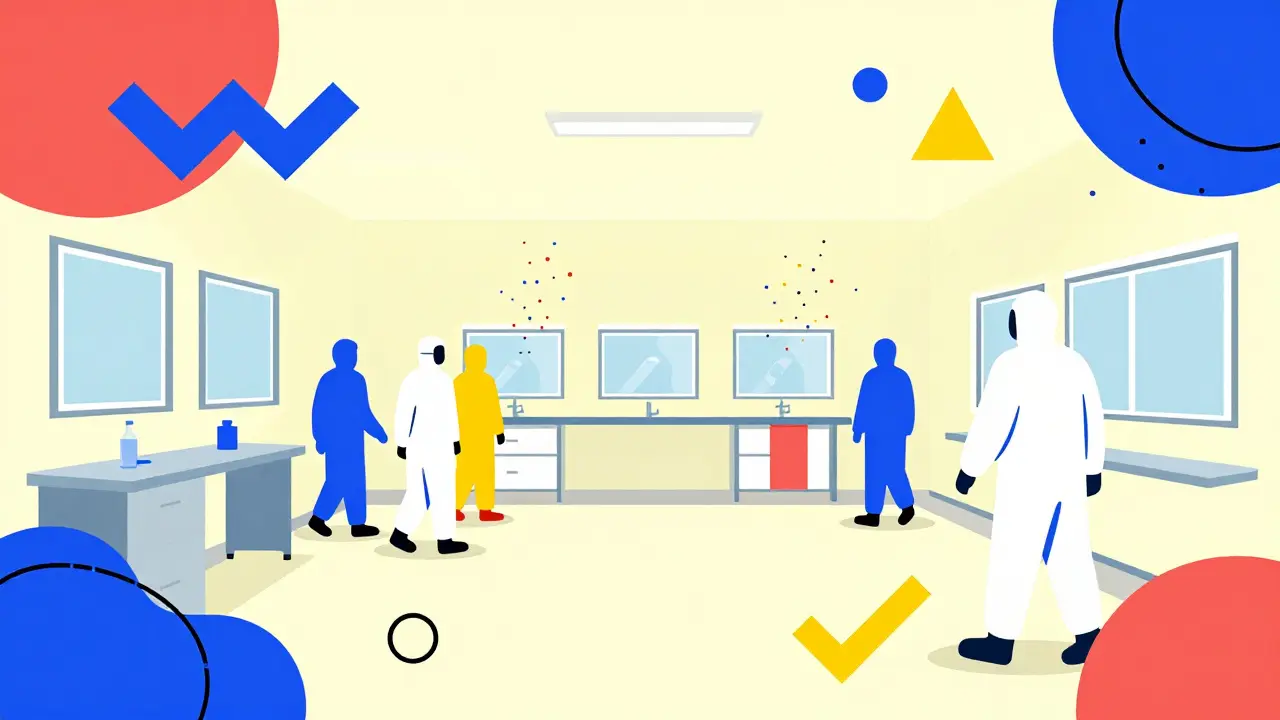
A pharmaceutical cleanroom is far more than a room with white walls and people in bunny suits. It is a highly engineered environment where every breath of air is filtered, counted, and controlled. The goal is simple but difficult: keep particles out. We are talking about particles smaller than human hair, some even smaller than bacteria.
The backbone of this control system is the Heating, Ventilation, and Air Conditioning (HVAC) unit combined with High-Efficiency Particulate Air (HEPA) filters. These H13 or H14 class filters trap 99.95% to 99.995% of particles as small as 0.3 micrometers. But filtration is only half the battle. The airflow itself must be managed precisely. In critical areas, air moves in one direction-unidirectional laminar flow-at speeds between 0.36 and 0.54 meters per second. This pushes contaminants away from the product rather than letting them swirl around randomly.
Pressure differentials play a crucial role too. Cleanrooms maintain positive pressure relative to adjacent less-clean areas. This means if a door opens, air flows out, not in. A typical differential is 10 to 15 Pascals. Temperature and humidity are also locked in tight ranges-usually 18-26°C and 30-60% relative humidity-to prevent static electricity buildup and microbial growth. Every variable is monitored continuously because in sterile manufacturing, there is no room for error.
Understanding Cleanroom Grades: ISO vs. GMP
If you look at regulatory documents, you will see two main classification systems: ISO 14644-1 and the EU GMP grading system (Annex 1). While they overlap, they serve different purposes. ISO classes focus strictly on particle counts, while GMP grades include both particle limits and viable microbial limits.
| GMP Grade | ISO Equivalent (At Rest) | Max Particles ≥0.5μm/m³ (Operational) | Typical Use Case |
|---|---|---|---|
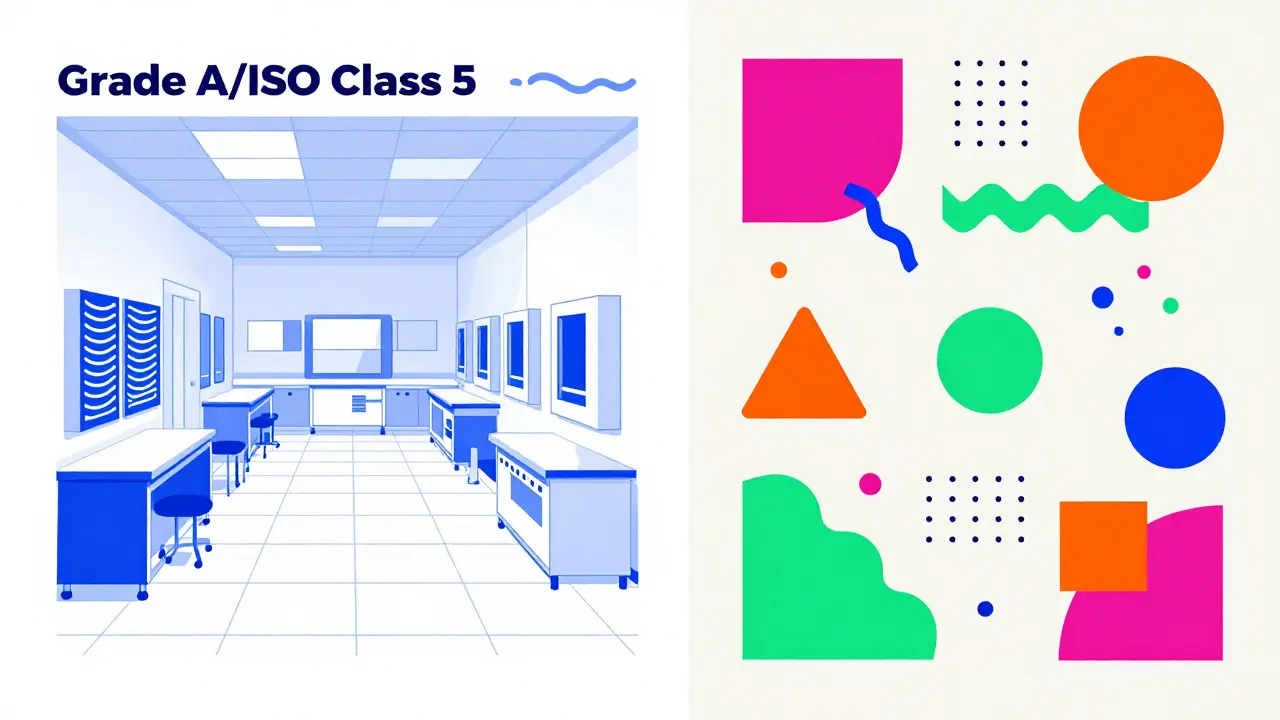
| Grade A | ISO Class 5 | 3,520 | Sterile filling, open vials |
| Grade B | ISO Class 7 | 3,520,000 | Aseptic processing support |
| Grade C | ISO Class 8 | 35,200,000 | Non-sterile compounding |
| Grade D | ISO Class 8 | No operational limit | Raw material handling |
Grade A is the gold standard. It requires unidirectional airflow and allows fewer than 3,520 particles per cubic meter during operations. This is where sterile injectables are filled. Grade B supports Grade A activities but has slightly looser particle limits when not actively processing. Grades C and D are used for less critical steps, such as preparing non-sterile ingredients or packaging. The key takeaway is that the stricter the grade, the higher the cost and complexity of maintenance.
Why Generic Drugs Face Stricter Scrutiny
You might wonder why generic drugs need the same rigorous cleanroom standards as brand-name innovators. The answer lies in bioequivalence. To get approval, a generic manufacturer must prove their drug performs identically to the reference listed drug (RLD) in the body. If the RLD was made in a Grade A cleanroom, the generic must meet the same environmental controls to ensure comparable purity and sterility.
This creates a unique challenge for generic makers. Innovator companies often enjoy profit margins of 70-80%, allowing them to invest heavily in state-of-the-art facilities. Generic manufacturers typically operate on 15-20% gross margins. Yet, they face identical regulatory hurdles. The FDA’s Abbreviated New Drug Application (ANDA) process demands proof that impurities and contaminants are within acceptable limits. Failure to maintain cleanroom integrity can lead to rejected batches, delayed approvals, or worse-product recalls.
Consider the 2012 meningitis outbreak linked to New England Compounding Center. Poor environmental controls led to fungal contamination in steroid injections, resulting in dozens of deaths. Since then, regulators have tightened requirements significantly. The European Union’s revised Annex 1, effective August 2023, mandates continuous monitoring and a robust Contamination Control Strategy (CCS). This shift reflects a move from reactive inspection to proactive risk management.
The Cost of Compliance: Real-World Impact
Building and maintaining a compliant cleanroom is expensive. According to industry data, constructing an ISO Class 5 cleanroom costs between $250 and $500 per square foot. For a mid-sized facility, this adds up quickly. Operational costs are equally steep. HVAC systems run 24/7, consuming massive amounts of energy. Personnel training alone can take 40-60 hours just for gowning certification.
Despite the costs, non-compliance is far more damaging. In 2022, Aurobindo Pharma faced a $137 million recall after inadequate Grade B monitoring allowed contamination in sterile injectables. Conversely, Teva Pharmaceuticals reported that upgrading to advanced isolator technology in Grade A areas reduced contamination events from 12 to 2 per year, ultimately securing FDA approval for a complex generic oncology drug.
Small manufacturers feel the pinch most acutely. One Reddit user shared that maintaining Grade A standards for a low-cost heparin syringe ($0.50/unit) made profitability impossible after repeated marginal excursions triggered by inspections. This highlights a growing tension: how do we ensure high-quality generics remain affordable when compliance costs rise?

Personnel: The Biggest Variable
Even the best HVAC system cannot stop contamination if people introduce it. Studies show that personnel gowning procedures are the most frequent source of deviations in cleanrooms. Humans shed thousands of skin cells and microbes every hour. In a Grade A environment, every movement must be deliberate and slow.
Training is critical. Workers undergo rigorous certification programs covering proper donning/doffing techniques, hand hygiene, and behavioral norms. Dr. Valerian Dunn’s 2022 study found that facilities investing in comprehensive training saw a significant drop in particulate excursions. However, fatigue and complacency remain risks. Real-time monitoring systems now help detect anomalies instantly, alerting staff before contamination spreads.
Cultural factors also matter. In emerging markets like India, infrastructure limitations make humidity control challenging. Tropical climates require specialized dehumidification systems that add 20-30% to HVAC costs. Yet, Indian manufacturers have risen to the occasion, spending an average of $4.2 million per facility to upgrade to Annex 1 standards, proving that geography doesn’t have to dictate quality.
Future Trends: Automation and Continuous Monitoring
The future of cleanroom standards points toward automation and real-time data analytics. McKinsey & Company projects that AI-powered monitoring and robotics could reduce operational costs by 25-30% by 2028. Imagine cameras detecting improper gowning or sensors predicting filter failures before they occur. This predictive approach minimizes downtime and enhances consistency.
Another trend is the rise of single-use systems in cleanrooms. The Parenteral Drug Association (PDA) is developing Technical Report 81 to address this shift, particularly for biosimilars. Single-use bags and tubing reduce cleaning validation burdens but introduce new material compatibility challenges. As complex generics grow in demand, expect cleanroom designs to evolve further, integrating modular units and flexible layouts.
Regulatory harmonization is also accelerating. The FDA plans to align its guidelines with the EU’s Annex 1 revisions, focusing on continuous monitoring and viable air sampling. This convergence simplifies global supply chains but raises the bar for all manufacturers. With 92% of FDA-inspected generic facilities now maintaining Grade A/B environments for sterile products, the industry is clearly moving toward higher standards.
What is the difference between ISO 14644-1 and GMP cleanroom grades?
ISO 14644-1 focuses solely on particle counts to classify air cleanliness levels (e.g., ISO Class 5). GMP grades (A-D) combine particle limits with microbial viability limits and specific operational requirements like airflow patterns and pressure differentials. GMP grades are legally binding for pharmaceutical manufacturing in many regions, while ISO classes provide a technical baseline.
Why do generic drugs need the same cleanroom standards as brand-name drugs?
Generic drugs must demonstrate bioequivalence to the reference listed drug (RLD). If the RLD was manufactured under strict environmental controls to ensure safety and efficacy, the generic must replicate those conditions to guarantee identical performance. Regulatory bodies like the FDA require this parity to protect public health.
How much does it cost to build a pharmaceutical cleanroom?
Construction costs vary widely based on size and classification. An ISO Class 5 (Grade A) cleanroom typically costs between $250 and $500 per square foot. Additional expenses include HVAC installation, HEPA filtration, monitoring systems, and personnel training. Operational costs can represent 15-25% of total facility capital expenditure for generic manufacturers.
What happens if a cleanroom fails compliance checks?
Non-compliance can result in FDA Form 483 observations, warning letters, import alerts, or mandatory product recalls. Severe cases may lead to consent decrees or shutdowns. Financial penalties can reach hundreds of millions of dollars, plus reputational damage that affects future market access.
Are cleanroom standards becoming stricter over time?
Yes. Recent updates like the EU GMP Annex 1 revision (2023) emphasize continuous monitoring and contamination control strategies. The FDA is aligning its guidance with these changes. Additionally, the rise of complex generics and biosimilars drives demand for higher-grade environments, pushing the industry toward more stringent practices.


Mark Ronson
May 14, 2026 AT 23:02Hey there, this is a really solid breakdown of the ISO vs GMP stuff. I work in HVAC for pharma facilities so i can tell you that maintaining those pressure differentials is no joke esp when you have doors opening all day. The part about unidirectional flow at 0.36-0.54 m/s is spot on because if you drop below that your laminar flow breaks down and you get eddies which trap particles. Its crazy how much energy these systems burn just to keep air moving in one direction but its necessary for sterile fill lines.
Mikey Mann
May 16, 2026 AT 23:01It makes me think about the philosophy of trust in modern society. We literally ingest invisible things made by people we will never meet in rooms we cannot see. The cleanroom is a temple of sorts where science meets strict ritualistic behavior to ensure safety. It is fascinating how much our health depends on these engineered environments rather than just the chemical formula itself.
Mollie Louise
May 18, 2026 AT 08:57Oh my gosh this is such an important topic!! 😲 I had no idea that generic drugs had to go through the exact same rigorous testing as brand name ones until now! 🤯 It gives me so much peace of mind knowing that there are strict rules like Annex 1 keeping everything safe 💊✨ The part about personnel being the biggest variable was eye-opening because I always thought it was just the machines doing all the work but humans shedding skin cells? Yikes! 🤢 Thanks for sharing this super detailed info it really helps us understand why prices might be high sometimes even for generics 💸🙌
Christina Moran
May 20, 2026 AT 04:30i live in india and the humidity control thing hit close to home lol. its so hard to keep moisture out when its 90% humidity outside every single day. we spend a fortune on dehumidifiers just to keep the grade c areas stable. its wild how geography affects manufacturing costs so much but yeah we are trying our best to meet annex 1 standards now.
mardy duffy
May 21, 2026 AT 14:18boring
Desirea Gaona
May 23, 2026 AT 09:54It is imperative that we recognize the systemic challenges faced by smaller manufacturers in emerging markets. While the regulatory framework is designed to protect public health, the financial burden of compliance can inadvertently stifle competition and reduce access to affordable medications. We must advocate for supportive measures that help these entities upgrade their infrastructure without compromising on quality standards.
Yuvraj Singh
May 25, 2026 AT 06:39Great point about the regional differences. In India, we have seen a massive shift towards adopting EU Annex 1 guidelines proactively. Many of our top manufacturers are now investing heavily in continuous monitoring systems not just to pass inspections but to build a reputation for reliability in global supply chains. It is a steep learning curve but the long-term benefits for patient safety and market access are undeniable.
Dana Ellington
May 25, 2026 AT 23:01wow i cant believe the meningitis outbreak was linked to poor environmental controls!!! 😱 that is absolutely terrifying to think about. thank goodness they tightened up the rules after that tragedy. it makes me so nervous thinking about all the little particles floating around in the air during production but i guess thats why they wear those full body suits right? 👗😷 anyway great article really opened my eyes!
victoria catharinaa
May 26, 2026 AT 20:51This is stupid. Why do we need so many rules? Just make the drug and let it be. The costs are too high and it hurts the poor people who need cheap meds. You guys are just making excuses for high prices. Fix it or shut up.
Glen Speck
May 28, 2026 AT 18:40the tension between cost and safety is real but cutting corners on sterility is not the answer. i have seen facilities try to save money on HVAC maintenance and end up with failed batches which costs way more in the long run. its better to invest in robust contamination control strategies from the start. also the trend towards automation will likely lower labor costs over time so maybe it will get cheaper eventually.