Ever stared at a prescription bottle and felt like you were reading ancient hieroglyphics? You aren't alone. The prescription label is a critical communication tool that bridges the gap between prescriber intent and patient action. For centuries, these labels relied on Latin roots to save space and standardize medical language across borders. But as healthcare moves into the digital age, those old-school shortcuts are becoming dangerous liabilities rather than helpful tools. Understanding what those tiny letters actually mean-and which ones you should be worried about-is the first step toward taking control of your own health.
The Origin of the 'Rx' Symbol and Latin Roots
You’ve probably seen the symbol Rx is the universal symbol for a prescription, derived from the Latin word 'recipe,' meaning 'take'. It wasn’t always a fancy logo; it started in the late 16th century when doctors wrote notes in Latin because it was the common language of European medicine. By 1598, the 'R' with a crossbar through it had become the standard shorthand for "take this." Today, while we don’t write prescriptions entirely in Latin anymore, the ghost of that era still haunts our medication bottles. Terms like per os (by mouth) or quaque die (daily) have stuck around because they are short. However, brevity comes at a cost. When a symbol is too small or written poorly, a quick glance can turn a harmless instruction into a serious mistake.
Categorizing Common Prescription Abbreviations
Not all abbreviations are created equal. They generally fall into five main buckets, each serving a specific function in the chain of care. Knowing which category an abbreviation belongs to helps you spot errors faster.
- Administration Route: Tells you how to take the med. p.o. is an abbreviation for 'per os,' meaning by mouth. Other examples include SC (subcutaneous injection) and p.r. (rectal).
- Dosage Frequency: How often you take it. b.i.d. means twice a day, t.i.d. three times a day, and q.i.d. four times a day. These come directly from Latin counting words.
- Anatomical Location: Crucial for eye and ear drops. o.d. stands for oculus dexter (right eye), and o.s. is oculus sinister (left eye). Getting these mixed up doesn’t just waste medicine; it can delay treatment for one eye while overtreating the other.
- Medication Type: Describes the form. ODT is an orally disintegrating tablet (dissolves on tongue), and LAI is a long-acting injection.
- Condition Codes: Sometimes appear on charts or labels to denote the diagnosis, such as OSA for obstructive sleep apnea or PAD for peripheral arterial disease.
High-Risk Abbreviations: The Danger Zone
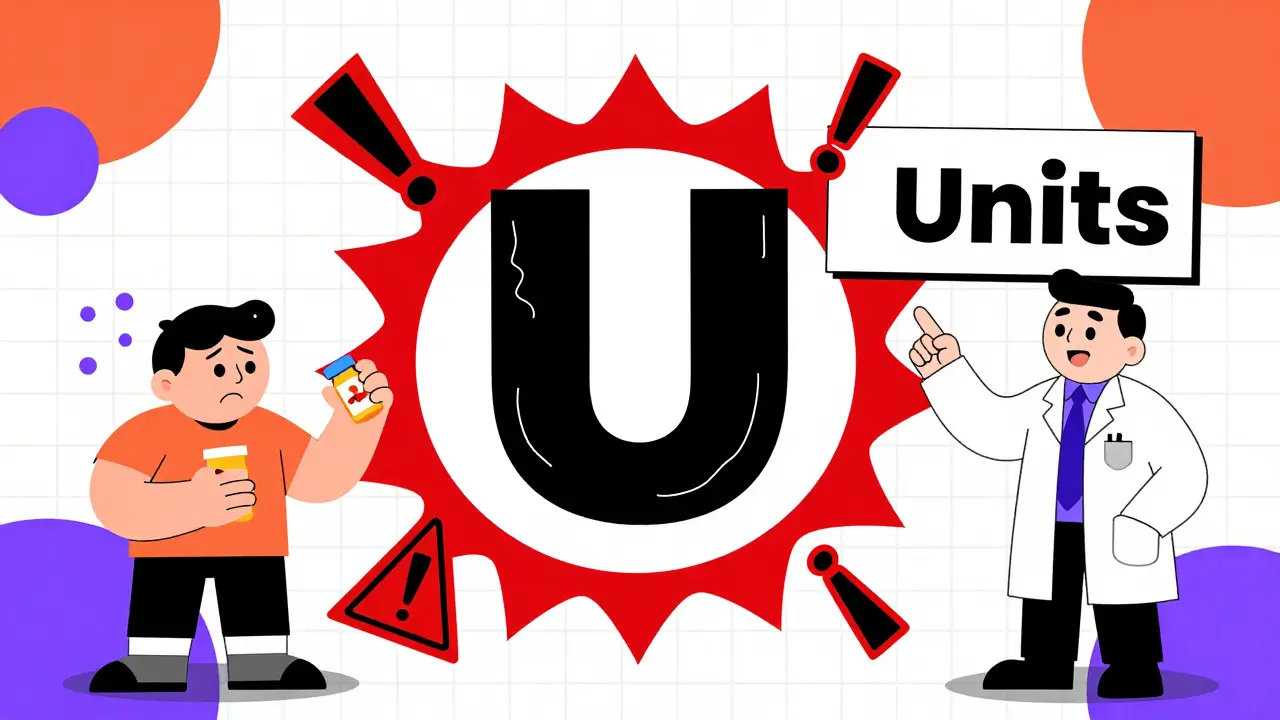
Here is where it gets tricky. Some abbreviations are so ambiguous that major safety organizations have banned them from use in hospitals. The Joint Commission maintains a list of "Do Not Use" abbreviations because they have caused real harm. Why? Because handwriting varies, and context isn’t always clear.
| Abbreviation | Intended Meaning | Risk / Misinterpretation | Safer Alternative |
|---|---|---|---|
| U | Units | Often misread as '0' or '4'. Caused 12.3 medication deaths in PA (2018-2022). | Write "units" |
| IU | International Units | Confused with IV (intravenous) in 8.7% of errors. | Write "international units" |
| QD | Once daily | Misread as QID (four times daily) due to poor handwriting. | Write "daily" |
| MS | Morphine Sulfate | Can mean Magnesium Sulfate. Near-misses reported weekly by technicians. | Write "morphine sulfate" |
| OD | Right Eye | Misinterpreted as "overdose" in 2,147 cases (AHA 2023). | Write "right eye" |
The data backs up the danger. According to the American Hospital Association’s 2023 report, nearly 14,000 incidents occurred across hundreds of hospitals simply because of these confusing symbols. If you see "1.0 mg" on a label, look out. A trailing zero can be mistaken for "10 mg," leading to a ten-fold overdose. This is why regulators now require a leading zero (e.g., 0.5 mg) but ban trailing zeros.
Regional Differences: US vs. UK Approaches
How you handle these symbols depends heavily on where you live. In the United States, the approach is nuanced. We allow some abbreviations if they are standardized, but we strictly ban the most dangerous ones. Electronic prescribing systems (CPOE) have helped significantly; Epic Systems data shows that 92.4% of U.S. hospitals using these systems saw a 43.2% drop in abbreviation-related errors. The software forces you to pick from a dropdown menu, eliminating bad handwriting.
In contrast, the UK took a more radical step. In 2019, the National Health Service (NHS) effectively eliminated almost all prescription abbreviations, mandating English-only prescriptions except for standard metric units like mg and mL. The result? A 28.7% reduction in dispensing errors, according to the British Journal of Clinical Pharmacology. While some doctors complained about the extra time it takes to type out "units" instead of "U," the safety gains have been substantial. Australia, where I’m based, is also moving in this direction, aligning with WHO guidelines that aim to eliminate non-English abbreviations globally by 2030.
What This Means for Patients
So, what should you do when you pick up your meds? Don’t just nod and walk away. Here is a practical checklist to ensure you understand your label:
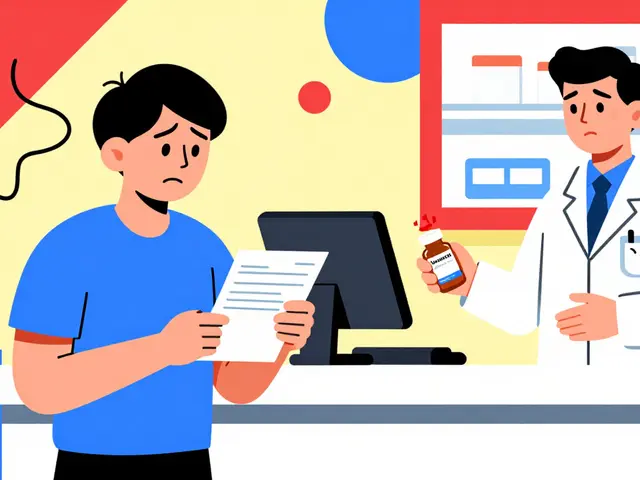
- Ask for Plain English: Most modern pharmacies, especially large chains like CVS or Walgreens, are converting labels to plain English. If yours still has "b.i.d.", ask the pharmacist to explain it or rewrite the label.
- Check for Ambiguity: Look for single letters like U, MS, or OD. If you see them, double-check with the pharmacist. Ask, "Does this mean units or something else?"
- Verify Eye/Ear Instructions: If you’re getting drops, confirm which eye or ear. "O.D." looks very similar to "O.S." if the dot is faint. Point to the correct side to be sure.
- Watch the Dose Format: Ensure there are no trailing zeros. 0.5 mg is safe; 0.50 mg is risky because the last zero might disappear in print, making it look like 0.5 or even 5 if misread.
Pharmacists are your best allies here. A 2023 survey found that 92.3% of pharmacists favor complete standardization to English terms. They want to get rid of the confusion too. Engaging them in conversation turns a passive receipt into an active safety check.
The Future: AI and Standardization
We are on the cusp of a major shift. AI-powered systems like IBM Watson Health’s MedSafety AI are already deployed in hundreds of hospitals, automatically converting abbreviations to standardized English with 99.2% accuracy. The World Health Organization’s 2023 challenge mandates the elimination of all non-English abbreviations by 2030. This isn’t just a tech trend; it’s a patient safety imperative. As electronic health records become universal, the need for human-readable, unambiguous language will only grow. The days of deciphering cursive Latin on a paper slip are numbered, replaced by clear, digital instructions that leave no room for guesswork.
What does 'Rx' stand for?
It comes from the Latin word 'recipe,' which means 'take.' It has been used since the 16th century to indicate a prescription.
Is 'U' for units safe to use?
No. The Joint Commission bans it because it is easily misread as '0' or '4,' leading to significant dosing errors. Always write or say 'units.'
What is the difference between o.d. and o.s.?
o.d. stands for 'oculus dexter' (right eye), and o.s. stands for 'oculus sinister' (left eye). Confusing them is a common source of medication errors in ophthalmic care.
Why are trailing zeros dangerous?
A number like 1.0 mg can be misread as 10 mg if the decimal point is missed. Leading zeros (like 0.5 mg) are required to prevent this, but trailing zeros are banned to avoid ambiguity.
Are prescription abbreviations being phased out?
Yes. The WHO aims to eliminate non-English abbreviations by 2030. Many countries, including the UK and parts of the US, are already moving toward plain English labels to improve safety.


Kathleen McGrath
August 24, 2026 AT 01:57This is such a great reminder to actually look at those labels! I always just nod and walk away, but now I feel like I have a real tool in my back pocket. It’s scary how much we rely on trust without understanding the basics. Thanks for breaking it down so simply!
Lemuel Gomez
August 25, 2026 AT 07:19I work in IT support, not healthcare, but even I get confused by the acronyms in software tickets; imagine what happens when a doctor's handwriting turns 'U' into a '4'. The NHS move makes perfect sense to me. Why keep the risk if you can just type it out? It’s a bit of extra time, sure, but safety first. Also, the trailing zero thing... who thought that was okay? Just curious, does this apply to vets too? I bet they still use Latin.
Emmanuel Umana
August 25, 2026 AT 22:49Latin as a universal language is a historical artifact, not a safety protocol. In Nigeria, we often see similar shorthand issues in local clinics where space is limited. The shift to plain English is a global imperative, not just a Western trend. Clarity saves lives.
Lilian Binda
August 26, 2026 AT 11:14yeah but its all about standardization right? why do americans still struggle with this while the uk got it sorted? feels like we are lagging behind again. typical. also the typo rate in these old scripts is insane. just write it out already
Fabian Saldana
August 27, 2026 AT 22:25It is indeed a monumental step forward for patient autonomy. By empowering individuals to decipher their own prescriptions, we reduce the cognitive load on healthcare providers and minimize the potential for catastrophic errors. This guide serves as an excellent educational resource for the general public.
Colin Finch
August 28, 2026 AT 07:53Ooh, the drama of misreading 'OD' as overdose! That’s terrifyingly plausible. I remember my GP writing things so small I needed a magnifying glass. It’s lovely that the NHS finally stepped up, though some of us old-school doctors grumbled about losing our artistic flair with cursive. But hey, accuracy beats aesthetics any day, wouldn’t you agree?
Betty Childers
August 30, 2026 AT 05:44My mom had a scare with eye drops once because the label was smudged. We ended up calling the pharmacy three times just to be sure which eye was which. So glad this is getting attention. It’s wild how something so simple can cause so much stress.
Amy Zalkin
August 30, 2026 AT 23:10honestly? i think the whole system is a bit chaotic sometimes. like why do we even need latin anymore? it’s like reading a spellbook. my pharmacist is nice but she writes like a spider crawled over her keyboard. love the colorful chaos of medical jargon tho, kinda cool in a weird way. just wish it was clearer lol
Alex Brown
September 1, 2026 AT 20:17The transition from symbolic shorthand to explicit semantic clarity represents a fundamental shift in medical epistemology. We are moving from a model of implicit trust in professional decoding to one of explicit shared understanding. This democratization of information is vital for true informed consent. The data on error reduction supports this philosophical stance strongly. It is a win for logic and safety alike.
Kaylyn Mello
September 3, 2026 AT 13:01so basically stop guessing right? yeah that makes sense. i never knew u could mean units or zero. scary stuff. glad they are fixing it. thanks for the heads up everyone
joyce Hogewoning
September 3, 2026 AT 18:39Oh my gosh, did you guys know that some hospitals actually banned the letter U entirely?! I mean, really? How do you even write 'units' without it? I feel like this is going to make everything so much slower but I guess if it stops people from taking ten times the dose then maybe it’s worth it? My neighbor took the wrong pill last year because the bottle looked similar and he almost had a heart attack so yeah, let’s just spell it out folks. No more hieroglyphics please. It’s just too risky and honestly a bit annoying when you’re trying to manage your meds and you can’t read the tiny print anyway.
Thhomas Fox
September 4, 2026 AT 00:53Good point. Simple fixes prevent big problems. Keep it clear.
Owen John
September 5, 2026 AT 13:50Of course, the WHO mandate is merely the tip of the iceberg. One must wonder if this standardization is truly for patient safety, or if it is a subtle mechanism to further centralize control within digital health platforms. The elimination of ambiguous symbols removes the 'human element' of interpretation, making us all more dependent on algorithmic accuracy. A convenient narrative for the tech giants, no doubt. The 'safety' rhetoric masks a deeper consolidation of power. One should remain skeptical of such sweeping changes without independent verification. The truth, as always, lies in the fine print they hope you won't read.
Maneesh kv
September 5, 2026 AT 14:43Great info 🙌 but in India we still see lots of confusion with mg vs mcg 😅. Spelling it out is key. Let's spread the word! 💪📝