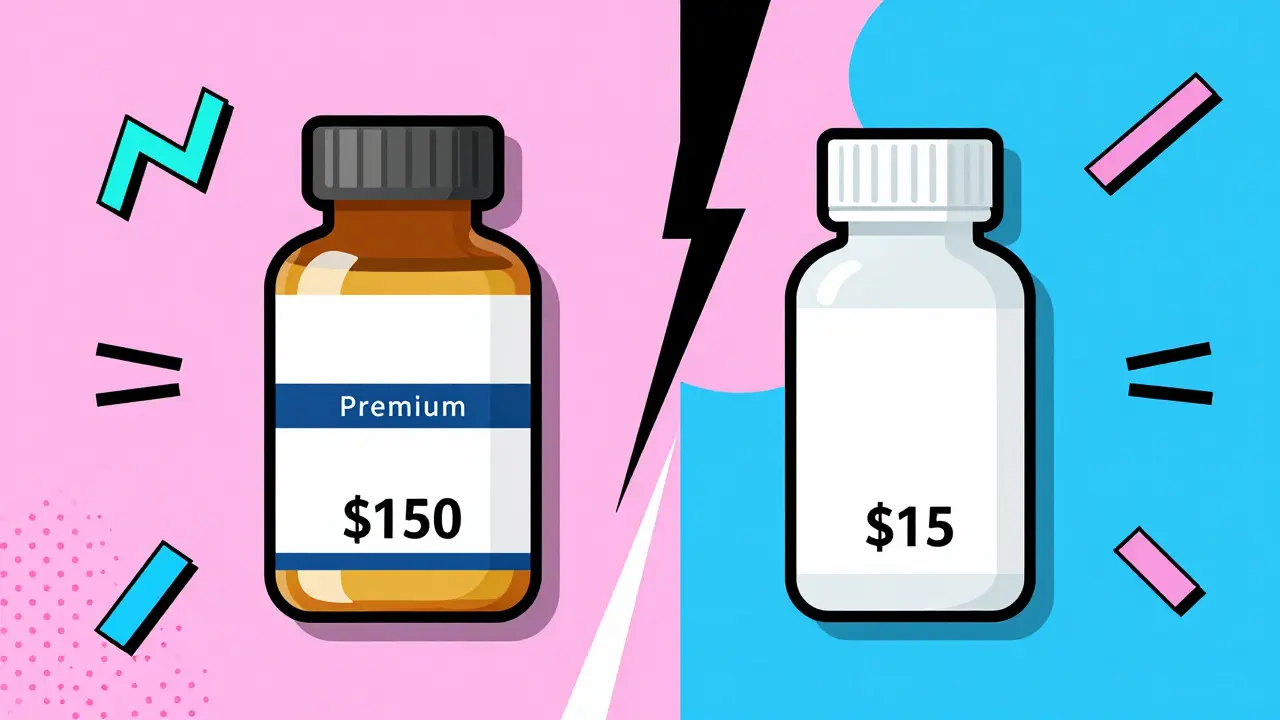
The Real Cost Gap: How Much Do You Actually Save?
When we talk about savings, we aren't talking about a few cents. The price difference is staggering. According to data from the Association for Accessible Medicines, generic and biosimilar medicines now make up about 90% of all prescriptions filled in the U.S., yet they only account for 12% of the total spending. Think about that for a second: the vast majority of medicine being used is the cheap stuff, while a tiny fraction of prescriptions (the brands) eats up almost all the budget. To put a concrete number on it, reports from Tebra show that generics typically cost about 79% less than their brand-name counterparts. In some cases, that's the difference between a manageable monthly expense and a financial crisis. Why is it so cheap? Because generic makers don't have to spend billions on the initial research, clinical trials, and massive advertising campaigns that the original brand did. They just have to prove the drug works the same way, which is a much cheaper process.How the FDA Ensures Generics Actually Work
One of the biggest hurdles to switching is the "trust gap." You might see that 84% of people believe generics are effective, yet over 60% still trust the brand name more. This usually stems from a misconception that generics use "lower quality" ingredients. In reality, the FDA (Food and Drug Administration) has incredibly strict rules. For a generic to hit the market, it must demonstrate bioequivalence. This means the drug must deliver the same amount of the active ingredient into your bloodstream in the same amount of time. Specifically, the pharmacokinetic parameters must fall within a tight 80-125% range of the brand-name product's performance. If it doesn't hit that window, it doesn't get approved. You're getting the same medicine; you're just not paying for the fancy logo on the bottle.The "Price Drop" Timeline: When Costs Plummet
Drug prices don't just drop overnight; they follow a predictable pattern based on competition. When the first generic enters the market, the brand-name company usually loses some pricing power, and the price might dip to 90% of its original cost. But the real magic happens as more competitors join in.| Number of Generic Competitors | Typical Price Level (vs Original Brand) | Estimated Savings |
|---|---|---|
| 1 Competitor | ~90% of original price | 10% reduction |
| 3-4 Competitors | 60-70% of original price | 30-40% reduction |
| 5+ Competitors | Below 50% of original price | 50%+ reduction |
Why Some Brand Drugs Stay Expensive
If generics are so great, why do some brand drugs still cost a fortune? It comes down to the Hatch-Waxman Act and patent law. Patents give a company a monopoly for a set number of years to recoup their R&D costs. Until that patent expires, the company can charge almost whatever they want. We see this in extreme cases with specialty drugs. While many common meds are cheap, some brand-name drugs with limited competition can maintain absurd pricing. For instance, Revcovi saw a price increase in early 2025 that added roughly $9,000 to the gross cost per prescription. When there is no generic alternative, the manufacturer holds all the cards.The Secret World of List Prices vs. Net Prices
If you look at the "sticker price" (the WAC or Wholesale Acquisition Cost) of a brand drug, it looks terrifying. But that's rarely what the pharmacy or insurance company actually pays. There is a massive gap between the list price and the net price. Manufacturers offer huge rebates and discounts to insurance companies and pharmacy benefit managers to ensure their drug is listed on the "preferred" list (the formulary). This means that even if the list price goes up by 2.3%, the actual net price might only go up by 0.1%. For the average person, this is why your copay might stay the same even if the news says the drug price skyrocketed. However, for those without insurance, the list price is the reality, making generics an absolute necessity.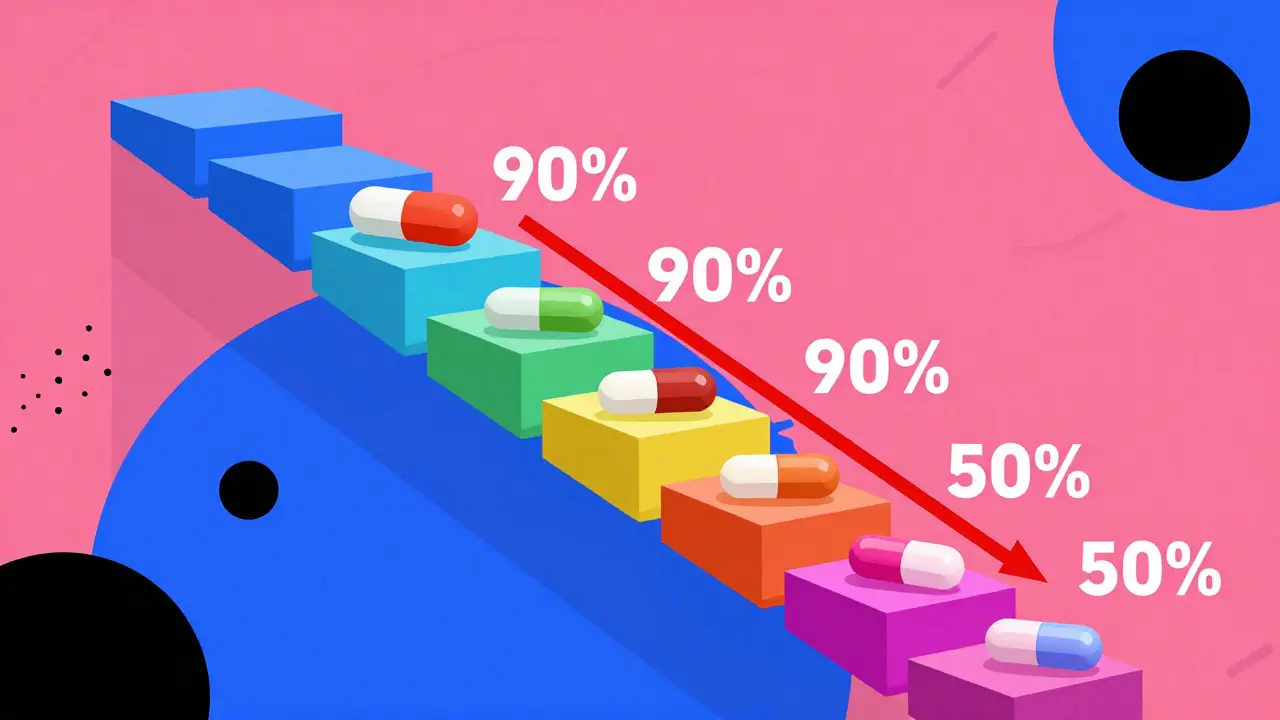
Making the Switch: Practical Steps to Save Money
If you're currently paying for a brand-name drug and want to switch, you don't have to guess. Here is the most direct way to handle it:- Ask for the "Therapeutic Equivalent": Ask your pharmacist if there is a generic version with the same active ingredient. Use the term "bioequivalent" to let them know you're looking for the FDA-approved equivalent.
- Check Your Formulary: Look at your insurance company's drug list. Often, they will refuse to cover the brand name if a generic exists, or they'll charge a much higher copay for the brand.
- Compare Multiple Pharmacies: Generic prices can vary wildly between a big-chain pharmacy and a local independent or a mail-order service.
- Ask About Biosimilars: If you are on a complex biological drug (like those for autoimmune diseases), ask about biosimilars. They aren't exact copies like chemical generics, but they are "highly similar" and significantly cheaper.
The Bigger Picture: How the U.S. System Balances Cost
There's a common narrative that the U.S. has the most expensive drugs in the world. While that's true for new brand-name drugs, it ignores the generic side of the coin. Because the U.S. has such a robust and competitive generic market, some studies-including one from the University of Chicago-find that U.S. public-sector net prices are actually 18% lower on average than in countries like Canada, Germany, or the UK. Essentially, the U.S. uses a "high-low" strategy: we pay a premium for the newest innovations (funding the next generation of cures), but we drive the cost of old, proven medicines down to nearly nothing. It's a brutal system for those without insurance, but it's the engine that keeps the global pharmaceutical pipeline moving.Are generic drugs less effective because they are cheaper?
No. The FDA requires generic drugs to be bioequivalent to the brand-name version. This means they must have the same active ingredient, strength, and delivery speed. The lower price is due to the lack of research and marketing costs, not a reduction in quality or efficacy.
Why does my generic medication look different from the brand name?
FDA regulations prohibit generics from looking exactly like the brand-name drug to avoid trademark infringement. While the active ingredients are identical, the "inactive ingredients" (fillers, dyes, and binders) can differ, which changes the color, shape, or taste of the pill.
Will my insurance cover a generic if I prefer the brand?
Most insurance plans have "generic substitution" policies. If a generic is available, they may only cover the cost of the generic. If you insist on the brand, you will likely have to pay the difference in cost out-of-pocket unless your doctor provides a medical necessity justification.
What is a biosimilar, and is it the same as a generic?
Biosimilars are for complex biological drugs made from living cells. Because these are too complex to copy exactly, a biosimilar is "highly similar" rather than identical. They are designed to provide the same clinical result as the original brand-name biological drug but at a lower cost.
When does a drug typically become available as a generic?
A drug becomes available as a generic after its patent expires. Patents usually last 20 years from the date of filing, though this can be extended. Once the patent ends, other companies can apply for an Abbreviated New Drug Application (ANDA) to launch their own version.

Nicole Antunes
April 23, 2026 AT 07:48It is truly wonderful to see a clear breakdown of how we can all save money on healthcare :)
Emma Cozad
April 25, 2026 AT 01:43Typical goverment nonsense lol. The FDA probly takes bribes from the big labs to let these cheap generics through. Most of these "savings" are just way to trick people into taking low grade meds while the elite keep the real stuff for thumsleves
Rick Brewster
April 25, 2026 AT 08:49the inherent duality of the pharmaceutical complex is truly a reflection of our late stage captilism where we value the spark of innovation only when it is fenced off by a legal monopoly for twenty years it is a fascinatng paradox that the very system meant to cure us relies on a mechanism that ensures a certain level of unaffordability for the masses until the clock runs out on a patent
Ajinkya Joshi
April 25, 2026 AT 23:59Oh sure, because the "high-low strategy" is totally a benevolent plan for global health and not just a convenient way for US companies to gouge everyone until they absolutely can't anymore. Pure genius.
Ally Warren
April 26, 2026 AT 21:09The distinction between the active ingredient and the filler is a metaphor for life itself; the essence remains unchanged while the external presentation shifts to suit the economic climate of the era.
Sarah Watters
April 27, 2026 AT 10:53The data here is suspect. Big Pharma probably funds the very studies saying generics are the same just to get the public to accept lower quality standards. It is all a coordinated effort to control the population via chemical dependency while claiming it is for our own benefit.
Divyanshu Giri
April 28, 2026 AT 05:55This is a total game changer man! Just swap the brand for the generic and boom you got more cash in your pocket for the fun stuff!! Super simple and super smart
vimal purwal
April 28, 2026 AT 06:48I must strongly concur with the assertion that the economic burden of medication is a global crisis, and while the provided data is illuminating, we must also acknowledge that the structural inequalities in healthcare access mean that even a generic drug is an unattainable luxury for those living in extreme poverty in developing nations, where the lack of regulatory oversight can lead to counterfeit medicines that mimic generics but lack any active ingredients at all, thereby creating a precarious situation for the most vulnerable populations who are desperate for any affordable relief available to them in their local markets.
Chidi Prosper
April 28, 2026 AT 12:28The point about biosimilars is particularly important because people often overlook them when they only think about simple pills.
Olayinka Ibukunoluwa Mercy
April 29, 2026 AT 06:44I am so glad we have this information!! It helps so many people feel empowered to talk to their pharmacists and save their hard-earned money!!! 💖✨🙏
Anantha Lakshmi
April 29, 2026 AT 21:00Let's all commit to checking our formularies today! Knowledge is power and saving money gives us more freedom to live our best lives! 🚀🌟💪
Dan Wizard
May 1, 2026 AT 00:00The explanation regarding the 80-125% pharmacokinetic range is a very helpful detail because it provides a scientific basis for the trust in generics, though it makes me wonder about the specific clinical implications for patients who might be hyper-sensitive to even small fluctuations in drug delivery, especially when dealing with medications that have a very narrow therapeutic index where a slight variation could potentially lead to either decreased efficacy or an increase in adverse side effects over a long period of time.