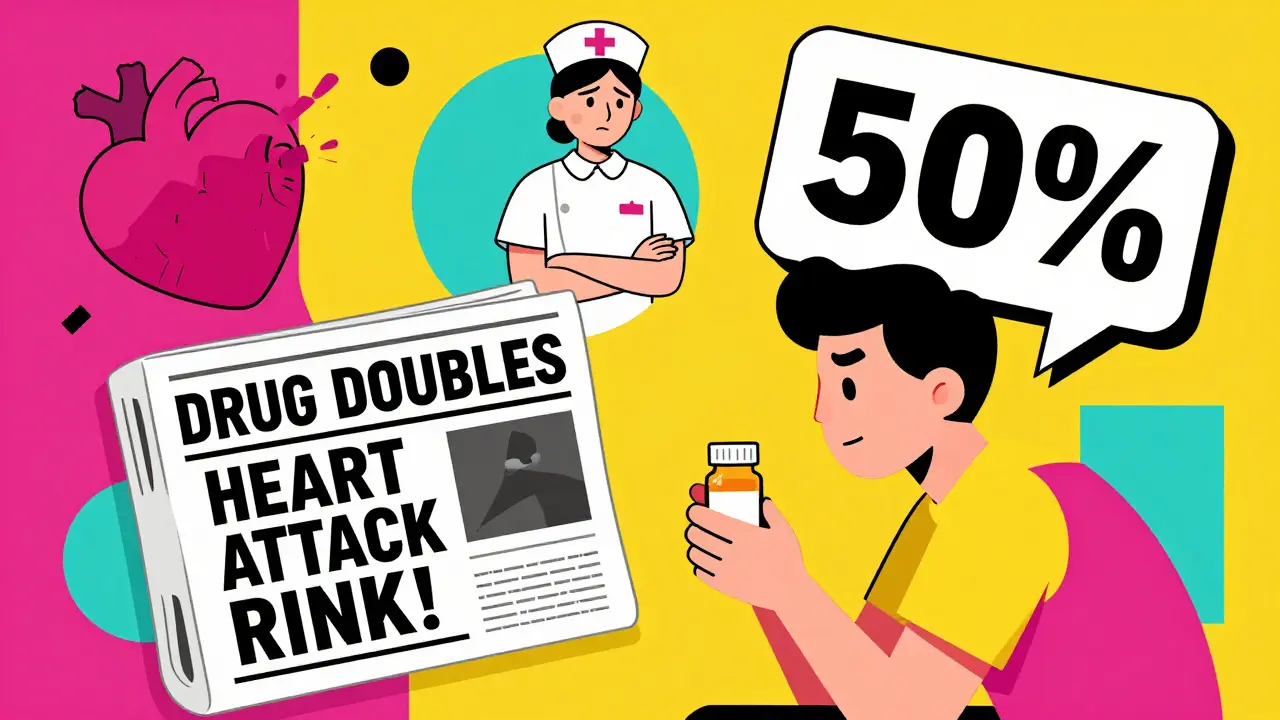
When you read a headline like "New Study Links Blood Pressure Drug to 50% Higher Risk of Heart Attack," it’s natural to panic. You might stop taking your medicine. You might call your doctor in a hurry. But here’s the truth: medication safety stories in the media are often misleading, incomplete, or outright wrong. And the consequences? People stop life-saving drugs. Others take unnecessary risks. The gap between what’s reported and what’s actually true can be deadly.
Understand the difference between medication errors and adverse drug reactions
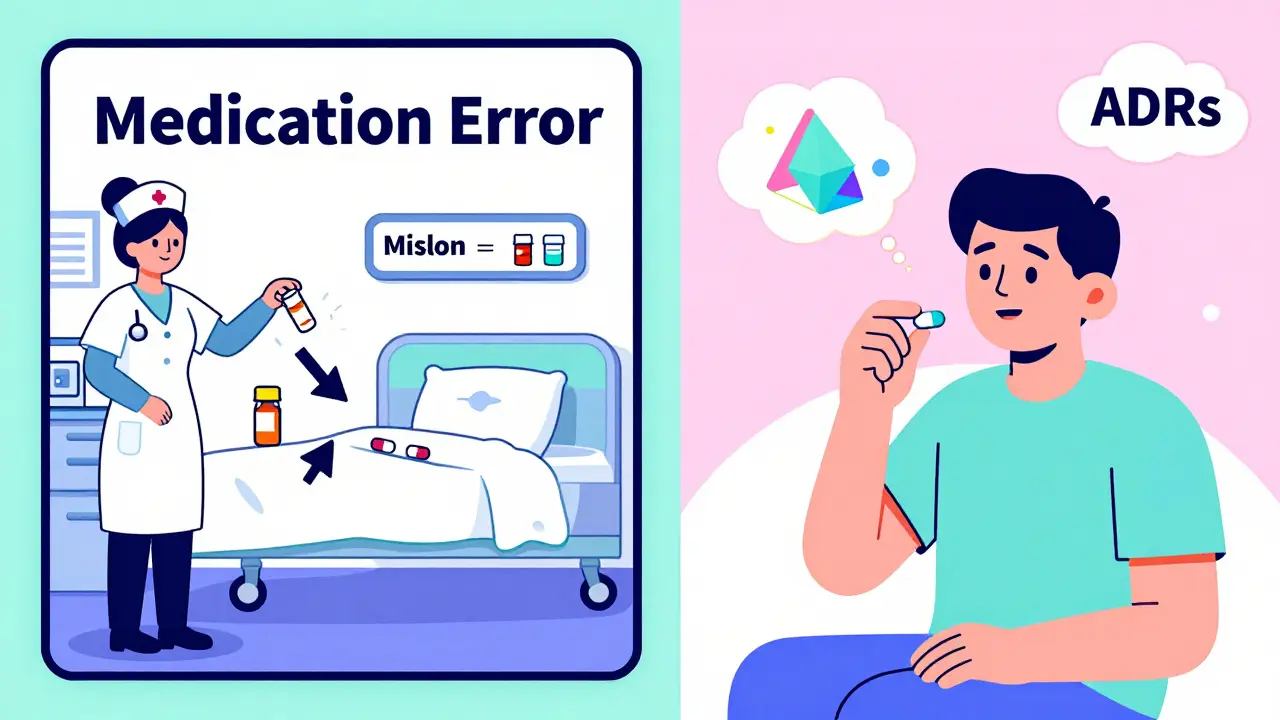
Not every bad outcome from a drug is the drug’s fault. Medication errors happen because of human or system mistakes-like a nurse giving the wrong dose, a pharmacist misreading a prescription, or a patient taking two pills by accident. These are preventable. Adverse drug reactions (ADRs), on the other hand, are side effects that occur even when the drug is used correctly. Some are rare but unavoidable. A news report that says "This drug caused 12 deaths" without clarifying whether those were errors or true ADRs is hiding critical context. A 2021 study in JAMA Network Open found that 68% of media stories about medication safety didn’t even say which type of event they were reporting on. That’s not just sloppy-it’s dangerous. If a report blames a drug for a mistake made by a hospital, you’re being misled. Always ask: Is this about the drug itself, or about how it was used?Look for absolute risk, not just relative risk
Here’s how media often tricks you: They say, "This drug doubles your risk of liver damage." Sounds scary, right? But what if your original risk was 1 in 10,000? Doubling it means 2 in 10,000. That’s still extremely rare. Absolute risk tells you the real chance. Relative risk sounds bigger, and that’s why reporters use it. A 2020 study in the BMJ analyzed 347 news stories and found that only 38% included absolute risk numbers. Cable news and digital outlets were worst-just 22% got it right. Print media did better, but still missed it half the time. If a report only says "risk increased by 80%" and doesn’t tell you the baseline, walk away. That’s not journalism. It’s fearmongering.Check the study method-and its limits
Not all safety studies are created equal. There are four main ways researchers track medication problems:- Incident report review: Hospitals and doctors report problems voluntarily. Easy to collect, but misses most cases. Only 5-10% of errors are reported.
- Chart review: Researchers dig through medical records. More thorough, but still only catches a fraction of real events.
- Direct observation: Someone watches doctors and nurses in action. The most accurate-but expensive and rare.
- Trigger tool: Uses specific red flags in electronic records (like a sudden spike in potassium levels) to flag possible problems. This is the most efficient method, used by top hospitals and endorsed by the Institute for Healthcare Improvement.
Don’t confuse reported incidents with proven causes
The FDA’s FAERS database and the WHO’s Uppsala Monitoring Centre collect hundreds of thousands of reports every year. But here’s the truth: These are spontaneous reports. They’re not proof. Someone takes a drug, gets sick, and reports it. Maybe the drug caused it. Maybe it was a coincidence. Maybe they had another illness. Maybe they took something else. A 2021 study in Drug Safety found that 56% of media stories treated FAERS data like it was proof of causation. That’s wrong. FAERS is a warning system, not a verdict. It’s like hearing 100 people say their car broke down after a fill-up-you don’t blame the gas station without checking the engine. Real safety studies use control groups, adjust for other factors, and look for patterns over time. Media rarely does.Verify claims with official sources
If a report says a drug is unsafe, go to the source. The FDA’s Sentinel Initiative, launched in 2023, uses real-world data from millions of patients to detect safety signals. The European Medicines Agency’s EudraVigilance system does the same. ClinicalTrials.gov shows the full design of studies-not just the headlines. A 2023 AHRQ survey found only 18% of reporters used Sentinel data. Most just copy-paste press releases. If you want to know if a drug is really risky, check these sites yourself. Look for the study’s sample size, control group, and how they handled confounding factors like age, other medications, or pre-existing conditions. If those aren’t there, the study isn’t reliable.Watch for red flags in language and sources
Here’s what to watch for:- Words like "deadly," "dangerous," "shocking," or "alarmingly"-these are emotional triggers, not facts.
- Quotes from "experts" without names or credentials-if they don’t say who they are, they’re probably not real.
- No mention of study limitations-every study has them. If they’re not mentioned, the reporter is hiding something.
- References to "new research" without a date or journal-is this a preprint? A retracted paper? A press release?
Be extra careful with social media
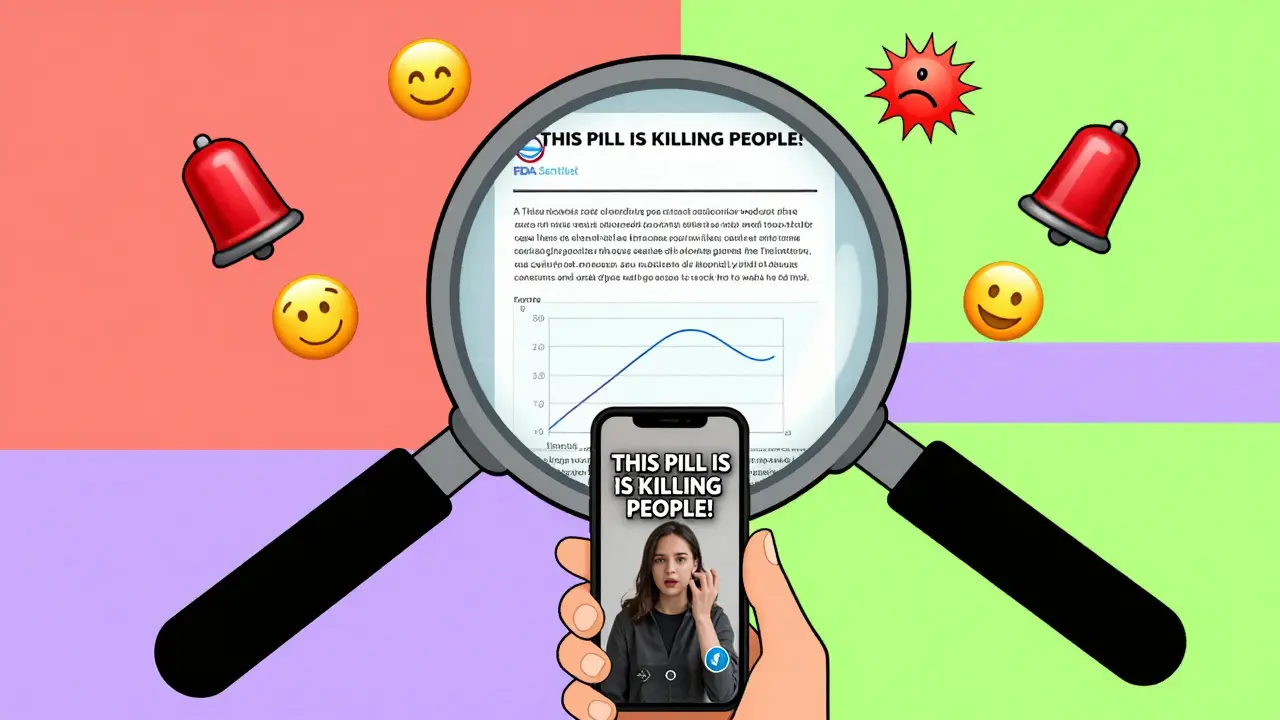
Instagram, TikTok, and Facebook are the worst offenders. A 2023 analysis by the National Patient Safety Foundation found that 68% of medication safety claims on social media were inaccurate. Videos showing someone’s cousin’s friend having a reaction? That’s not data. It’s anecdote. And anecdotes don’t prove anything. One viral TikTok in 2022 claimed a common blood pressure pill was "killing people." The study it cited used doses 10 times higher than what’s prescribed. The video had 8 million views. The correction? 12,000.What should you do when you see a report?
Here’s your simple checklist:- Does it distinguish between medication errors and adverse drug reactions?
- Does it give absolute risk, not just relative risk?
- Does it name the study method (trigger tool, chart review, etc.) and its known limits?
- Does it cite the original source-like FAERS, ClinicalTrials.gov, or a peer-reviewed journal?
- Does it mention confounding factors or limitations?
- Is the tone alarmist, or calm and factual?




Lance Long
January 28, 2026 AT 16:55I used to panic every time I saw a headline like 'Drug X Linked to Heart Risk'-until I learned how to read the fine print. Now I check the absolute risk first. If my chance of liver damage goes from 0.01% to 0.02%, I’m not stopping my med. I’m just laughing at the clickbait.
Medias love doubling numbers because it sounds scary. But if you’re 70 and on three other pills, your real risk isn’t the drug-it’s the headline.
My grandma stopped her blood thinner after a TikTok video. She had a stroke. Don’t be her.
Always ask: Who funded this study? Is it a preprint? Is there a control group? If not, it’s not science-it’s theater.
Timothy Davis
January 29, 2026 AT 03:59Let’s be real-most of these media reports aren’t just misleading, they’re criminally negligent. The fact that 68% of stories don’t even distinguish between medication errors and ADRs? That’s not incompetence. That’s malpractice by journalists.
And don’t get me started on FAERS data being treated like peer-reviewed evidence. It’s a garbage bin of anecdotal noise. Anyone who cites it as proof hasn’t read a single epidemiology textbook.
Trigger tools? Yes. Chart reviews? Meh. Incident reports? Useless. The only reason this stuff gets published is because editors don’t know the difference between correlation and causation-and they’re too lazy to call a cardiologist for a 5-minute fact-check.
Also, 'dramatic language'? That’s not journalism. That’s reality TV with a byline.
fiona vaz
January 29, 2026 AT 11:34This is such an important post. I’m a nurse, and I see the fallout every day-people stopping statins because of a viral post, or switching to herbal supplements because some influencer said it’s 'natural.'
It breaks my heart. Medications save lives. But fear? Fear kills.
Thank you for laying out the checklist. I’m printing this out and giving it to every patient who comes in worried about a headline. We need more of this-calm, clear, factual guidance.
Also, please share this with your local newsroom. They need to see it.
Sue Latham
January 30, 2026 AT 05:29Oh honey, you’re telling me the media doesn’t just make everything sound like a horror movie? Shocking.
I mean, I read that 'new study' about metformin causing cancer last week. It was on my cousin’s friend’s Instagram. The caption? 'They don’t want you to know this.'
Turns out? It was a 2009 rat study with doses equivalent to 10,000 human pills. But nope-my aunt stopped her diabetes med. Now she’s in the ER.
Also, 'absolute risk'? What’s that? Sounds like something only PhDs understand. Meanwhile, I’m just trying not to die before my next Zoom call.
John Rose
January 31, 2026 AT 03:39Great breakdown. I appreciate how you emphasized methodology. Most people don’t realize that a study using spontaneous reports is like listening to people complain about their car after a bad oil change-it doesn’t prove the mechanic is bad.
I’ve started using ClinicalTrials.gov to check the original studies behind headlines. It’s a habit I wish I’d developed years ago.
One thing I’d add: Look at the sample size. A study with 47 participants isn’t a national warning. And if the journal is obscure or predatory? Walk away.
Also, if the article doesn’t mention the drug’s brand name or generic name? That’s a red flag. You can’t evaluate safety if you don’t know what you’re evaluating.
Lexi Karuzis
February 1, 2026 AT 23:16Brittany Fiddes
February 2, 2026 AT 21:37Oh, this is so typical. American media-so obsessed with sensationalism they forget what journalism even is. In the UK, we actually have a system called NICE that evaluates these things properly. No one here screams 'DANGER!' over a 0.01% risk increase.
And yet, you lot still treat every minor correlation like it’s the next Chernobyl. It’s exhausting. We have real problems-like underfunded NHS wards-but you’re all too busy panicking over a headline that says 'drug doubles risk' without mentioning the baseline was one in a million.
At least we don’t have TikTok influencers prescribing meds. You’re lucky we still have the BMJ. You? You have Buzzfeed.
jonathan soba
February 4, 2026 AT 17:46Just to clarify: The 2021 JAMA study didn’t say 68% of stories didn’t distinguish between errors and ADRs-it said 68% of the studies cited in those stories didn’t make the distinction. Big difference.
Also, trigger tools aren’t 'endorsed by IHI'-they’re used by some hospitals because they’re cost-effective. That doesn’t mean they’re perfect. They miss 30% of events.
And FAERS? It’s not 'a warning system.' It’s a database. The FDA uses it to generate hypotheses, not conclusions. But nobody here reads the footnotes.
Bottom line: This post is mostly right, but it’s still oversimplifying. That’s the problem.
Chris Urdilas
February 5, 2026 AT 09:17Wow. I came here for drama. I left with a life hack.
So here’s the real secret: If you want to know if a drug is safe, don’t read the news. Don’t scroll TikTok. Don’t even ask your cousin’s neighbor who ‘knows a guy.’
Go to the FDA website. Type in the drug name. Look at the ‘Warnings’ section. If it says ‘may cause dizziness,’ that’s it. That’s the whole story.
Everything else? Noise.
Also, if a headline says 'shocking new study,' it’s probably a press release from a university trying to get grant money. I’ve seen it 50 times.
Kathy Scaman
February 6, 2026 AT 14:39I’m just here to say I read this whole thing. And I didn’t fall asleep. That’s a win.
Also, I stopped my beta-blocker last year because of a YouTube video. I didn’t tell anyone. I’m not proud. But I started reading actual studies after this. I’m back on it now.
Thanks for not yelling. Just telling us how to think. That’s rare.
Anna Lou Chen
February 6, 2026 AT 23:37Deconstructing the epistemic hegemony of pharmaceutical epistemology through the lens of postmodern pharmacovigilance reveals that media narratives are merely symptomatic of a deeper ontological crisis in biomedical discourse.
The binary framing of 'safety' versus 'danger' is a colonial construct imposed by the Western biomedical apparatus to suppress embodied knowledge and alternative healing modalities.
FAERS data, as a technocratic artifact, functions as a disciplinary mechanism-pathologizing patient subjectivity and privileging quantified risk over lived experience.
One must ask: Who benefits from the myth of 'absolute risk'? The FDA? The insurance industry? The algorithmic attention economy?
Perhaps the real danger isn’t the drug-it’s the epistemological violence of reductionist science.
Have you considered that your anxiety about medication is a symptom of capitalist alienation?
Try grounding. Or crystals. Or both.
Mindee Coulter
February 7, 2026 AT 17:14