
You touch a hot stove. You pull your hand back instantly. That split-second reaction isn't just instinct; it's nociceptive pain, defined by the International Association for the Study of Pain (IASP) as pain arising from actual or threatened damage to non-neural tissue. It is your body’s essential warning system, designed to prevent further harm. But when that signal stays on-whether from a twisted ankle, a bruised rib, or chronic arthritis-it becomes a problem you need to solve.
Understanding what nociceptive pain actually is helps you choose the right medication. Most people grab whatever is in their cabinet, but not all painkillers work the same way. The choice between NSAIDs and acetaminophen isn't random. It depends entirely on whether your pain involves inflammation.
What Exactly Is Nociceptive Pain?
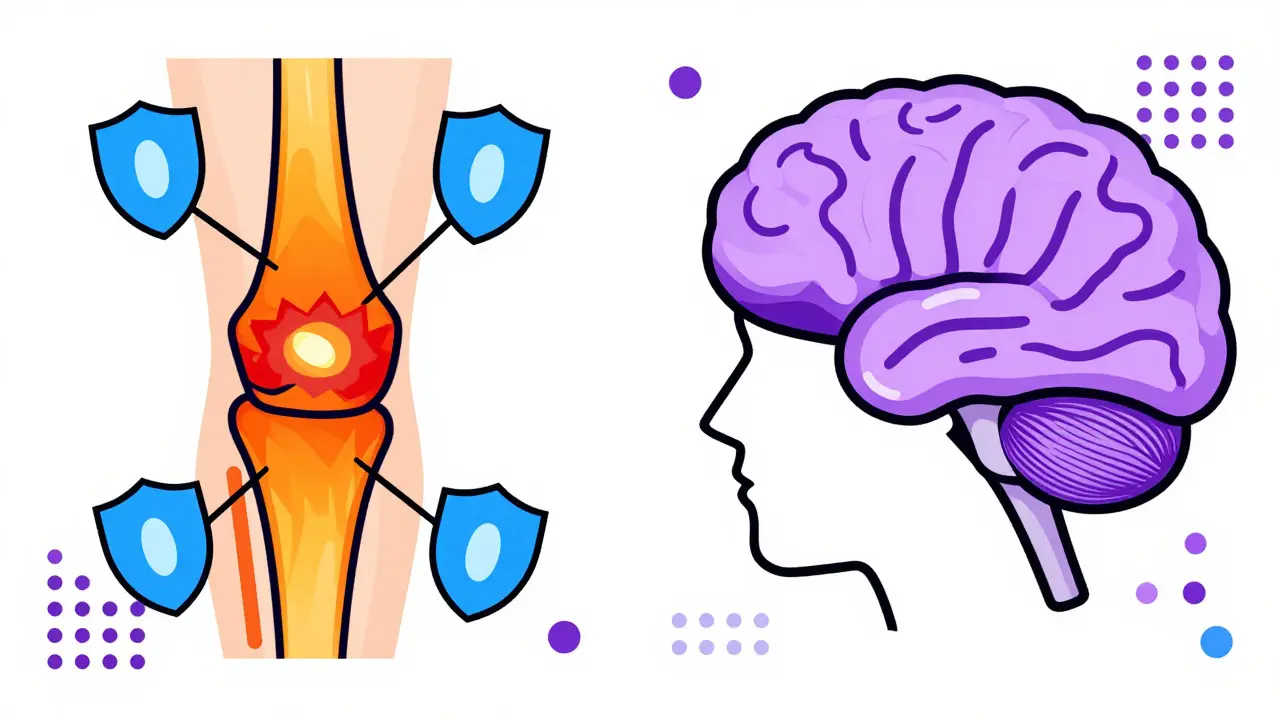
Nociceptive pain is different from nerve pain (neuropathic) or central sensitization (nociplastic). It comes from specific sensors called nociceptors located in your skin, muscles, bones, and organs. When these sensors detect heat, pressure, or chemical changes caused by injury, they send signals to your brain.
There are three main types of nociceptive pain, each feeling distinct:
- Superficial somatic pain: This affects the skin. Think of a paper cut or a burn. It feels sharp and well-localized because fast-conducting Aδ fibers carry the signal at speeds up to 30 meters per second.
- Deep somatic pain: This hits ligaments, tendons, bones, and muscles. A sprained ankle or a broken bone falls here. It feels dull, aching, and hard to pinpoint exactly because slower C fibers transmit the message.
- Visceral pain: This originates in internal organs like the stomach or intestines. It often feels like cramping or pressure and can be referred to other areas of the body.
The key takeaway? If your pain is linked to visible swelling, redness, or heat, you are dealing with inflammatory nociceptive pain. If it’s a mild ache without those signs, the mechanism is different. This distinction dictates your treatment.
NSAIDs vs. Acetaminophen: How They Work Differently
Many people use these two drugs interchangeably, but their biological targets are worlds apart. Knowing this difference saves you from taking ineffective medicine.
NSAIDs (Non-Steroidal Anti-Inflammatory Drugs), such as ibuprofen and naproxen, work by blocking cyclooxygenase (COX) enzymes. These enzymes produce prostaglandins, chemicals that cause inflammation and sensitize pain receptors at the site of injury. By stopping prostaglandin production, NSAIDs reduce both pain and swelling at the source.
In contrast, Acetaminophen (also known as paracetamol) has very little anti-inflammatory effect in the body. Its exact mechanism remains partially debated, but research suggests it works centrally in the brain and spinal cord, possibly by inhibiting COX-3 isoforms and modulating serotonin pathways. It turns down the volume of pain signals without fixing the peripheral inflammation.
| Feature | NSAIDs (e.g., Ibuprofen) | Acetaminophen (Paracetamol) |
|---|---|---|
| Primary Action | Blocks COX enzymes; reduces inflammation | Central nervous system modulation; minimal anti-inflammatory effect |
| Best For | Injuries with swelling, arthritis, sprains | Mild headaches, fever, minor aches without inflammation |
| Efficacy (Musculoskeletal) | High (49% achieve 50% pain relief) | Moderate (39% achieve 50% pain relief) |
| Main Risk | Gastrointestinal bleeding, cardiovascular events | Liver toxicity (hepatotoxicity) if overdosed |
| Max Daily Dose | Varies (e.g., Ibuprofen 1200mg OTC) | 3000-4000mg (lower if liver issues exist) |
When to Choose NSAIDs
If your injury involves swelling, stiffness, or obvious tissue damage, NSAIDs are usually the better first-line choice. A 2023 Cochrane Review involving over 7,800 patients found that ibuprofen provided significantly better relief for acute musculoskeletal injuries compared to placebo. Specifically, 49% of patients taking 400mg of ibuprofen achieved at least 50% pain reduction, compared to only 32% in the placebo group.
This makes sense biologically. In conditions like osteoarthritis or an acute ankle sprain, inflammation is driving the pain. Dr. Clifford Woolf, a leading neurobiologist at Harvard Medical School, notes that NSAIDs target the peripheral source of pain generation. By reducing the inflammatory mediators at the injury site, you aren't just masking the pain; you're helping the tissue heal faster. Clinical guidelines from the American College of Rheumatology strongly recommend NSAIDs for osteoarthritis precisely for this reason.
However, there is a catch. Because NSAIDs inhibit COX-1 enzymes in the stomach lining, they can increase the risk of ulcers and gastrointestinal bleeding. Long-term users face a 1-2% annual risk of serious GI events. If you have a history of stomach issues, talk to your doctor about taking a proton pump inhibitor (PPI) alongside your NSAID, which can reduce ulcer risk by up to 74%.
When Acetaminophen Makes Sense
Acetaminophen shines when inflammation isn't the primary driver. For tension-type headaches or mild, generalized aches, it is often preferred because it lacks the gastrointestinal side effects of NSAIDs. The American Headache Society gives it Level A evidence for treating tension headaches, noting that adding an NSAID offers minimal additional benefit for these specific disorders.
It is also the go-to for pediatric care. According to 2023 guidelines from the American Academy of Pediatrics, 92% of pediatricians prefer acetaminophen for children due to its safety profile regarding the stomach. Similarly, geriatricians often favor it for elderly patients who may be at higher risk for NSAID-induced kidney strain or heart issues.
But don't expect miracles for deep tissue injuries. A 2022 JAMA meta-analysis showed acetaminophen had limited efficacy for acute low back pain, with a Number Needed to Treat (NNT) of 10.2. This means you’d need to treat ten people with acetaminophen for one person to get significant relief, whereas ibuprofen’s NNT was much lower. If you have a swollen knee, acetaminophen might take the edge off the sensation, but it won't reduce the swelling.
Safety First: Risks and Limits
Both drugs are powerful tools, but misuse leads to real danger. The biggest misconception is that "natural" or "OTC" means harmless.
NSAID Risks: Beyond stomach issues, high-dose NSAIDs like diclofenac can double the risk of myocardial infarction (heart attack) in susceptible individuals. The FDA mandates black box warnings for this cardiovascular risk. If you have high blood pressure or heart disease, consult your physician before starting regular NSAID therapy.
Acetaminophen Risks: Liver toxicity is the silent killer here. The maximum recommended daily dose is generally 4,000mg, but the FDA now advises capping it at 3,000mg for many adults to provide a safety buffer. Since acetaminophen is hidden in hundreds of cold and flu combinations, it is easy to accidentally overdose. Exceeding 150-200mg/kg can be fatal. Always check labels carefully.
Practical Strategy: What Should You Do?
So, how do you decide? Use this simple decision tree based on your symptoms:
- Is there swelling, redness, or heat? Yes → Choose an NSAID (like ibuprofen 400-600mg every 6-8 hours). Start within 2 hours of injury for best results.
- Is it a mild headache or fever without swelling? Yes → Choose Acetaminophen (650-1000mg every 6 hours).
- Do you have stomach issues or heart risks? Yes → Avoid NSAIDs; stick to Acetaminophen or ask your doctor about topical NSAIDs (gels), which have only 30% systemic absorption compared to oral forms.
- Is the pain severe and mixed? Consider combination therapy. A 2022 Mayo Clinic survey found that 61% of chronic pain patients used both drugs together, reporting 32% better control than either alone. Just ensure you track your total acetaminophen intake across all medications.
Pain is data. Listen to what it tells you about your body. If nociceptive pain persists beyond a few days despite proper medication, it’s time to see a professional to rule out deeper structural issues.
What is the fastest acting painkiller for tissue injury?
For inflammatory tissue injuries like sprains, NSAIDs such as ibuprofen typically act faster and more effectively than acetaminophen because they target the source of inflammation. Starting an NSAID within 2 hours of injury can optimize pain relief and reduce swelling.
Can I take NSAIDs and acetaminophen together?
Yes, for most healthy adults, taking NSAIDs and acetaminophen together is safe and can provide superior pain relief. Studies show combination therapy can improve pain control by 32% compared to using either drug alone. However, always adhere to the maximum daily doses for each medication separately.
Why doesn't acetaminophen help with swelling?
Acetaminophen works primarily in the central nervous system to block pain signals. It has negligible effects on peripheral COX enzymes, which are responsible for producing prostaglandins that cause inflammation and swelling. Therefore, it treats the sensation of pain but not the underlying inflammatory process.
Are topical NSAIDs safer than oral ones?
Generally, yes. Topical NSAIDs like diclofenac gel have significantly lower systemic absorption (around 30%) compared to oral forms (up to 80%). This reduces the risk of gastrointestinal and cardiovascular side effects while still delivering anti-inflammatory action directly to the affected joint or muscle.
How long should I take NSAIDs for an acute injury?
For acute injuries like sprains or strains, evidence-based protocols suggest using NSAIDs for 3 to 7 days. Prolonged use increases the risk of side effects. If pain persists beyond a week, consult a healthcare provider to assess healing progress and adjust treatment.