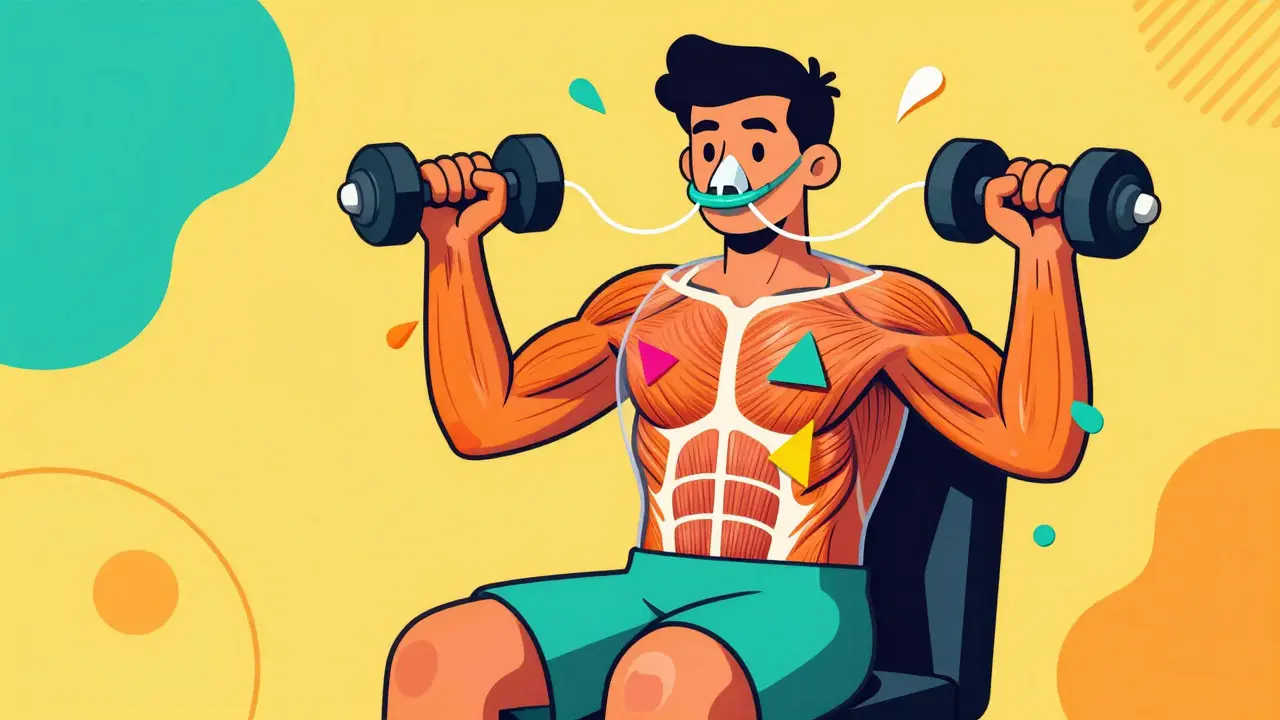
When you have COPD, breathing gets harder. But what most people don’t realize is that your muscles are also breaking down - and fast. Sarcopenia, the loss of muscle mass and strength, affects about 22% of people with COPD. That’s more than 1 in 5 patients. And it’s not just about weakness. It’s about survival. People with COPD and sarcopenia are 20-40% more likely to die than those without it. The good news? This isn’t inevitable. With the right nutrition and resistance training, you can rebuild strength, walk farther, breathe easier, and even live longer.
Why Sarcopenia Hits Harder in COPD
Sarcopenia doesn’t just happen because you’re getting older. In COPD, it’s a perfect storm. Your body is constantly fighting inflammation. Oxygen levels drop, especially at night. You’re tired, so you move less. And many people just don’t eat enough protein. All of this adds up.Unlike normal aging, where muscle loss starts in the legs, COPD-related sarcopenia hits the upper body and breathing muscles first. Studies show 68% of COPD patients have noticeable shrinking of the pectoralis muscles - the ones that help you lift your arms and breathe in. That’s compared to just 22% in healthy older adults. This isn’t just about walking. It’s about getting out of bed, lifting a coffee cup, or tying your shoes.
The rate of muscle loss is also faster. Healthy aging loses about 1-2% of muscle per year. In COPD? It’s 3.2%. That’s nearly double. And it’s tied directly to how bad your lung disease is. The lower your FEV1 (the number that measures airflow), the worse your muscle loss. A 2022 study found a strong link - the more severe your COPD, the more muscle you lose.
How Doctors Diagnose It
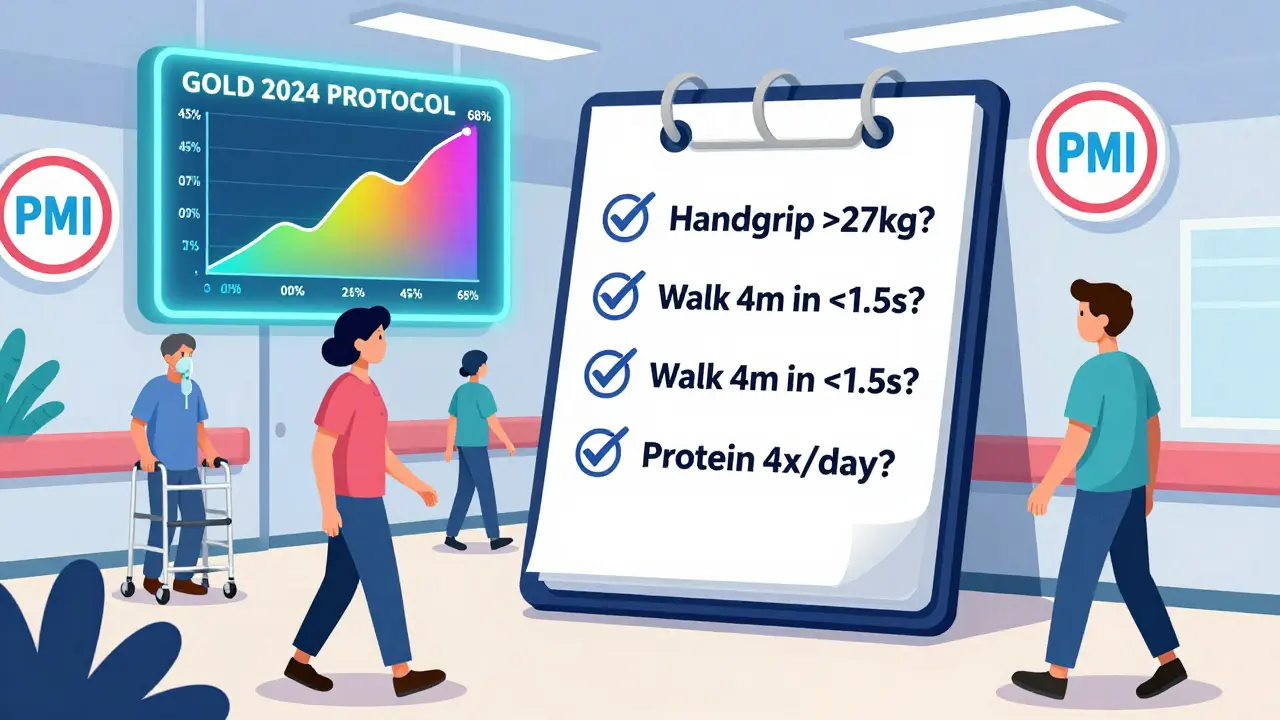
Most doctors don’t screen for sarcopenia unless they’re in a specialized clinic. But it’s simple to check. The European Working Group on Sarcopenia (EWGSOP2) says the first sign is low muscle strength - not size. That means testing handgrip strength. For men, less than 27 kg; for women, less than 16 kg. That’s a red flag.Then they look at movement. Can you stand up from a chair without using your arms? Can you walk four meters in under 1.5 seconds? The Short Physical Performance Battery (SPPB) measures this. A score below 8 means your physical performance is impaired.
For COPD patients, standard BMI tests don’t work well. Many are thin, but still carry extra fat around their belly. That’s why newer methods like the pectoralis muscle index (PMI) are being used. It measures the size of the chest muscle on a CT scan, adjusted for body size. A PMI below 1.06 cm²/BMI is a strong predictor of sarcopenia in COPD.
Some clinics use DEXA scans to measure muscle mass in the arms and legs. For men, less than 7.0 kg/m²; for women, less than 5.5 kg/m². But these aren’t always needed. Handgrip strength and walking speed are often enough to start treatment.
Nutrition: The Foundation of Muscle Recovery
Most people with COPD eat too little protein. The average intake? Just 0.8-1.0 grams per kilogram of body weight. But the science says you need 1.2-1.5 grams per kilogram. That’s a 30-50% increase.Why? Because your body is under constant stress. Inflammation from COPD blocks muscle building. To fight back, you need more protein - and you need to spread it out.
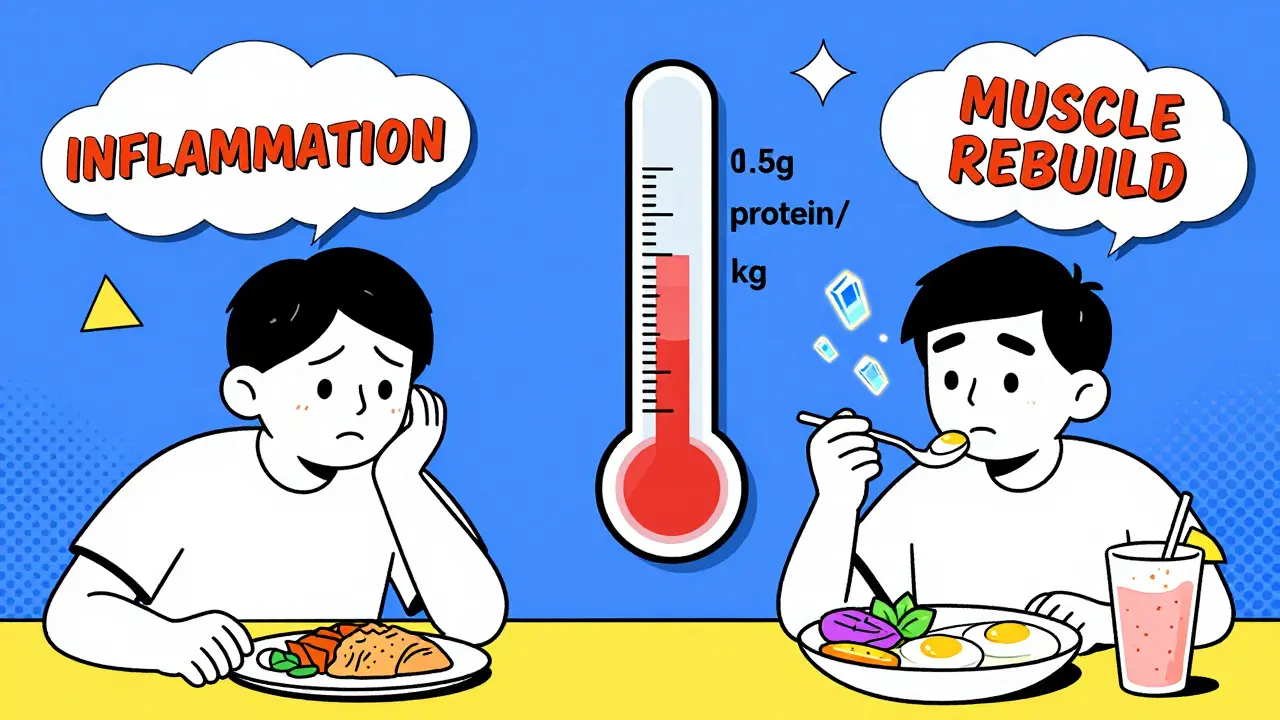
Don’t just eat a big protein dinner. Eat 0.3-0.4 grams per kilogram at each meal. That means if you weigh 70 kg, aim for 21-28 grams of protein per meal, four times a day. So breakfast, lunch, dinner, and a snack.
Leucine is the key amino acid that triggers muscle growth. Foods like eggs, chicken, Greek yogurt, and whey protein are rich in it. But many patients can’t eat enough whole food. That’s where supplements help. Adding 2.5-3.0 grams of leucine per meal (often found in whey protein powders) boosts muscle synthesis by 37%, according to a 2023 study in Clinical Nutrition.
For patients with appetite loss - common in advanced COPD - liquid supplements with 10g of leucine and 20g of protein can be easier to tolerate. They’re often used between meals or as meal replacements.
And don’t forget calories. If you’re not eating enough total energy, your body will burn muscle for fuel. Adding healthy fats like olive oil, nuts, or avocado can help without making you feel full too fast.
Resistance Training: How to Start Without Worsening Breathlessness
The fear? “Exercise will make me more short of breath.” And yes - 42% of COPD patients need supplemental oxygen during resistance training. But skipping it makes things worse.Research shows that resistance training improves 6-minute walk distance by 28% more in COPD patients than in non-COPD sarcopenic people. That’s huge. It means you can walk farther, climb stairs, carry groceries.
But standard gym routines don’t work. You need a modified plan.
Start at 30-40% of your one-rep maximum (1-RM). That’s light. For many, that means 1-2 pound dumbbells or light resistance bands. Focus on major muscle groups: arms, shoulders, chest, legs. Do 2-3 sets of 10-15 reps, 2-3 times a week.
Rest 2-3 minutes between sets. This lets your breathing recover. Use a chair. Sit down if you need to. No need to stand if it makes you dizzy.
Progress slowly. After 4-6 weeks, if you’re not gasping, increase the weight by 5-10%. The goal isn’t to lift heavy. It’s to build endurance and strength over time. Most people see real changes in 8-12 weeks.
Use oxygen if you need it. If you’re on home oxygen, use it during training. It’s not a sign of weakness - it’s a tool. One patient, Mary Thompson, 68, said: “After 12 weeks of bands and protein, I could carry groceries again.”
Always train under supervision if possible. Pulmonary rehab programs are designed for this. They monitor your oxygen levels, breathing rate, and fatigue. If you’re doing this at home, use a pulse oximeter. If your oxygen drops below 88%, stop and rest.
What Happens When You Don’t Act
Ignoring sarcopenia isn’t passive. It’s dangerous. Patients who don’t address muscle loss have higher hospitalization rates - 32% higher - and lower survival. One 2021 study found that treating sarcopenia in COPD could increase 5-year survival from 45% to 68% in severe cases.And it’s not just physical. Weakness leads to isolation. You stop going out. You stop doing things. Depression and anxiety follow. The cycle gets worse.
Many patients quit because of breathlessness. John Peterson, 72, wrote on Reddit: “The resistance exercises made my breathing so much worse. I had to stop.” But he didn’t know about oxygen support or starting light. That’s the gap. Education matters.
Real-World Results and Barriers
At the Cleveland Clinic, 78 COPD patients with sarcopenia did 16 weeks of resistance training and protein supplements. Their 6-minute walk distance improved by 23%. That’s the distance of two city blocks - enough to make a real difference in daily life.But only 38% of U.S. pulmonary rehab centers screen for sarcopenia. Most don’t. That’s changing slowly. Academic hospitals are ahead - 67% screen. Community clinics? Only 28%.
Barriers? Time, training, and resources. Doctors aren’t trained to check grip strength. Patients don’t know what to eat. Insurance doesn’t always cover protein supplements or supervised training.
Still, the evidence is clear. A 2023 health economics study in Value in Health found that addressing sarcopenia in COPD saves money. It reduces hospital stays, improves quality of life, and extends life. It’s one of the most cost-effective interventions available.
What’s Next
The GOLD guidelines released their first COPD-specific sarcopenia algorithm in 2024. It now includes nighttime oxygen monitoring as part of the plan. Early results show a 29% drop in muscle loss among those following it.Trials are testing new drugs. One, called PTI-501, targets myostatin - a protein that limits muscle growth. It’s in phase 2 trials and could be available by 2026.
Supplements like HMB (beta-hydroxy-beta-methylbutyrate) are also being studied. In a 2024 European trial, HMB combined with resistance training preserved 18% more muscle than placebo.
By 2027, experts predict sarcopenia screening and management will become standard in COPD care. Not optional. Not extra. Core.
It’s not about curing COPD. It’s about living better with it. Your muscles matter. And you can rebuild them - one rep, one meal, one breath at a time.


Allison Priole
March 21, 2026 AT 13:16man i never realized how much muscle loss was tied to breathing in COPD. i thought it was just about the lungs, but wow - the pectoralis muscles shrinking first? that explains why my mom could barely lift her coffee cup anymore. she’s 71 and has had COPD for 12 years. we started doing light resistance bands with her, and she’s actually been able to get up from the couch without help now. it’s not magic, but it’s something. also, protein snacks between meals? game changer. she used to skip breakfast, now she’s eating greek yogurt at 10am. small wins, ya know?
Casey Tenney
March 22, 2026 AT 20:09Stop wasting time with bands. Just get a lung transplant.
Bryan Woody
March 23, 2026 AT 13:10you people are treating sarcopenia like it’s a hobby. it’s a biological emergency. 3.2% muscle loss per year? that’s not aging. that’s your body being slowly cannibalized by inflammation. and no, eating a protein shake at dinner doesn’t cut it. you need 21g per meal, 4x a day. period. and resistance training? not at the gym. at home. with a chair. with oxygen on. no excuses. if you’re too tired to lift 2lbs, you’re already losing. the science is clear. you’re just choosing to ignore it because it’s inconvenient. get your grip strength tested. right now. not tomorrow.
Timothy Olcott
March 24, 2026 AT 20:57they’re hiding the truth 🤫. COPD isn’t just from smoking. it’s 5G towers + chemtrails + big pharma making you weak on purpose. they don’t want you strong. they want you dependent on oxygen and protein shakes. i saw a video where a guy lifted 10lbs and his oxygen dropped. that’s not muscle loss. that’s a trap. i stopped all supplements. now i just drink lemon water and walk barefoot on grass. breathing better already 🌿😎
Thomas Jensen
March 26, 2026 AT 02:44they say this is about nutrition and training... but what about the fact that hospitals overprescribe steroids? those things destroy muscle tissue. and why is no one talking about mold in homes? i’ve been in 3 different apartments with black mold. my legs gave out. i got tested. my cortisol was through the roof. this isn’t about protein. it’s about environmental poisoning. they don’t want you to know. you’re being gaslit by the medical industrial complex. i’m not weak. i’m poisoned.
matthew runcie
March 26, 2026 AT 21:35appreciate the breakdown. i’ve been doing the 1.5g/kg protein thing for 6 months. not glamorous, but i can carry my own laundry now. small things matter. also, using oxygen during training? yes. it’s not weakness. it’s strategy.
shannon kozee
March 27, 2026 AT 09:26handgrip strength is the easiest screen. if you can’t open a jar, you’re already at risk. start there.
trudale hampton
March 28, 2026 AT 00:12my dad did this program. 16 weeks. 23% improvement in walk distance. he went from barely making it to the mailbox to walking the whole block to the corner store. he said the leucine supplement tasted like chalk, but he did it anyway. not because he was brave. because he wanted to hug his grandkids without getting winded. that’s the real win.
Shaun Wakashige
March 28, 2026 AT 00:29lol i tried the bands. got tired. gave up. 😴
Paul Cuccurullo
March 29, 2026 AT 14:56It is profoundly moving to witness the convergence of physiological science and human resilience in this context. The data presented is not merely clinical-it is deeply existential. To rebuild muscle is to reclaim dignity. One must approach this endeavor with solemnity, discipline, and reverence for the body’s capacity to heal.
Solomon Kindie
March 29, 2026 AT 22:09they say protein and reps but what about the real issue? the body is a system. if your liver is detoxing 24/7 from inflammation, no amount of whey is gonna fix it. you need to detox the lymphatic system. alkaline diet. fasting. maybe even sauna. they’re all missing the forest for the trees. also why is no one talking about the microbiome? gut health affects muscle synthesis. it’s all connected. i read a paper once. it was 2014. they knew. they just didn’t want you to
Natali Shevchenko
March 31, 2026 AT 10:21i’ve been thinking about this a lot. muscle loss isn’t just physical. it’s emotional. when you can’t lift your arm to wave at your neighbor, you start to disappear. not from the disease. from the world. the real cost of sarcopenia isn’t in hospital stats. it’s in the silence. the missed birthdays. the hands that stop reaching out. we talk about protein grams and FEV1 numbers. but we don’t talk about the loneliness that comes with being too weak to hold a spoon. maybe the first rep isn’t about strength. maybe it’s about saying: i’m still here.
Johny Prayogi
March 31, 2026 AT 11:32just started the leucine supplement. 2.5g with breakfast. already feel less tired by noon. also using my oxygen during bands. no shame. 🚀💪
Nicole James
April 2, 2026 AT 06:18who funded this study? big pharma? who sells the protein shakes? who owns the CT scanners? who profits when you’re weak? why is the pectoralis muscle index only available in academic hospitals? why not in every clinic? why is it 2024 and we still need a scan to prove you’re losing muscle? someone’s making money off your weakness. i’m not buying it. the real solution? stop smoking. and stop trusting the system.